Monday, September 12, 2011

144: Ceriagrion calamineum (Lieftinck, 1951)

Number: 144 / Family: Coenagrionidae / Genus: Ceriagrion
Species: Ceriagrion calamineum /  Turmeric-yellow Marsh Dart*
Habitat: Open, Ponds, Usually Surrounded by Tree Cover
Province(s) sighted: Nakhon Ratchasima, Bueng Khan
In flight: July-August / Sightings (by me): Uncommon
Species easily confused with: Many Ceriagrion Species

I know colour isn't a good way to identify odonata. I also know that identifying Ceriagrion can really difficult with some species. However, on a recent trip to Khao Yai I spotted a damselfly that just seemed different to all the others. The colours were similar (but slightly more orange) to that of C. indochinense. However, it's size eliminated C. indochinense straight away (the latter is larger, in my experience anyway). Anyway, it turns out that it is a new species (well, most probably), known as Ceriagrion calamineum. Since then, I have only managed to spot a solitary male in a large partially flooded open field on the edge of forest in Bueng Khan. sadly, I am yet to see the female.

The Male
The male is a kind of 'burnt orange' or as suggested in the Thai name, the colour of turneric. It also has pale green eyes. 


The first time I saw the species... there were many at Khao Yai (though not seen then there since)


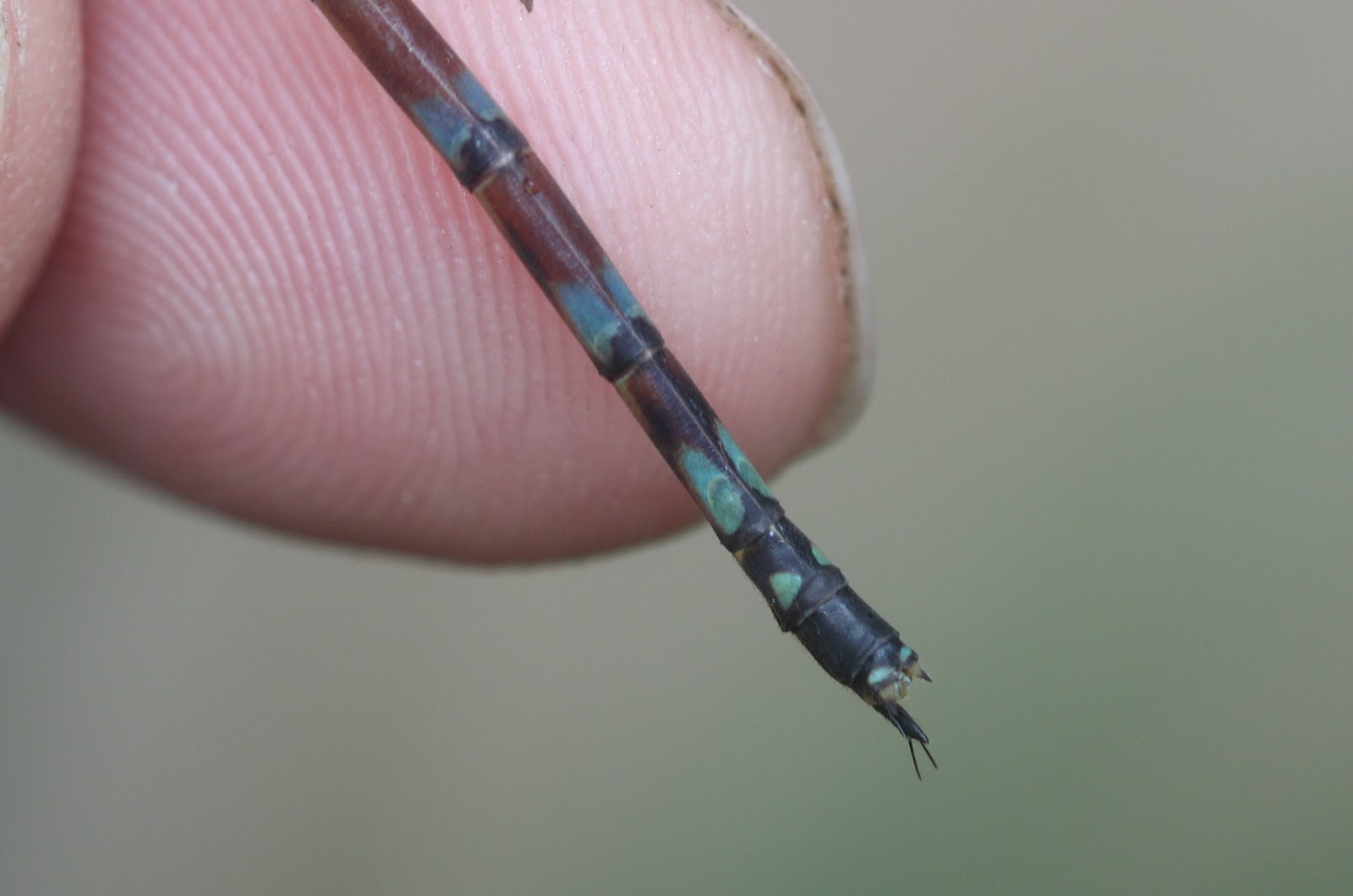
In the hand... 
This gives an idea of its size.


Here, I placed him against my lighter for a better idea of size (I will get round to measuring that exact size one day).


I didn't get to see any females, but the males were commonplace at one location in Khao Yai NP.

Once again, many thanks to Noppadon Makbun and Oleg Kosterin for the ID (both are pretty sure it's the correct ID)

Wednesday, September 7, 2011

143: Noguchiphaea yoshikoae (Asahina, 1976)

Number: 143
Family: Calopterygidae
Genus: Noguchiphaea
Species: Noguchiphaea yoshikoae
Common name(s): N/A
Thai name(s): แมลงปอเข็มตาปีกสั้นโยชิโกะ
Habitat: Heavily forested uplands stream (approx. 900-1000 metres)
Province(s) sighted:  Stream/waterfall at Phu Rua National Park (Loei)
Sightings (by me): Fairly common only at this location
In flight (that I have seen): September (though must be longer)

After spotting a new provincial record earlier that day, I arrived at Phu Rua NP. It was too late in the day to look at the river then, so I had to wait until morning. 

A was up at 5 am, coffee, cigarette, some noodles and I was off... I walked down to the river (there are two ways to get there and I took the slippery route, of course). I had to cross a tiny stream that I could hardly see because of seriously heavy mist. Just before the stream, I noticed a male Coeliccia poungyi. Then I looked up and saw a NEW SPECIES right in front of me, sitting in the trees (It was full of dew from the mist). Anyway, I saw this species and then saw many more specimens throughout the day. It turns out to be Noguchiphaea yoshikoae, a species previously recorded only in Chiang Mai and Vietnam, so a new species for me and another provincial record! Two provincial records in one trip AND I saw both male and female!

The mature male
It looks very similar to Vestalis smaragdina, but there are a few differences. It is smaller, has protrusions dorsally on the synthorax and the genitalia is more complex (it has a kind of brownish hook - you can see it if you look closely). Also, the white dorsal patch is solid from S8-10, whereas V. smaragdina it only covers part of S8 (from what I can tell anyway). They also seem less skittish than V. smaragdina.


I spotted several perching high up in this position... looking down on a stupid fat foreigner taking photos of their friends.


In the hand...
This gives an idea of size. This I managed to catch with my fingers.


Here is the genitalia (notice the brownish 'hook')


N. yoshikoae vs. V. smaragdina appendages...
Here you can see another difference between the two species. The caudal appendages are different and the white dorsal patch is different (S8 on N. yoshikoae is solid white, whereas it's only partially covered on V. smaragdina).
(top, N. yoshikoae; bottom, V. smaragdina)


The sub-adult male
The male is the same as the adult, but the dorsal patch on S8-10 and the caudal appendages are grey, not white.


Here's the first specimen I saw at about 6 a.m., which had a lot of early morning dew from the mist.


The teneral male...
I also briefly saw a teneral male, which had clearly only just taken to flight. The bugger still managed to fly high up into the trees before I managed to get really good photos though. Still, this one is OK.


The female
I was also lucky enough to spot the female. At this stream/waterfall, the females were fairly abundant. They are almost identical to the male, but slightly more robust. Also, the protrusions (like little horns) on the synthorax are far more apparent. 


In the hand...
I also caught this female with my fingers. She flew away safely afterwards.


Many, many thanks once again to Noppadon Makbun for confirmation of ID and for providing lots of useful information on the species. 

Sunday, September 4, 2011

142: Gynacantha phaeomeria (Lieftinck, 1960)

Number: 142 / Family: Aeschnidae / Genus:  Gynacantha 
Species:  Gynacantha phaeomeria / Dark-thighed Dusthawker*
Habitat: Forested Areas Along Rivers
Province(s) sighted: Kalasin, Loei
Sightings: Rare / In flight (that I have seen): June-September
Species easily confused with: All Gynacantha species

*As it doesn't have a common name, I decided upon 'Dark-thighed' relating to 'phaeomeria' meaning 'dark' and one feature of dark thighs/legs, as well as Gynacantha species being known as 'Duskhawkers'.

It was a weekend of agony and ecstasy at Phu Rua National Park and environs. Heavy rain, heavy mist, bad judgement on locations and a lot of driving, nearly put paid to my weekend trip.

After a sleepless night, I set off from Khon Kaen at 1am and arrived in Phu Rua at around 5.30 am with a few stops here and there. After a few bad choices on ponds (maybe it was too early in the morning), I tried my luck at the national park. Closed. Upon asking a man with a dog, who said "It's closed in the rainy season", I drove to another waterfall called Namtok Pla Ba, not too far away. It was part of an enormous river and the water was belting through at an unbelievable pace. The waterfall was low down and inaccessible, as too was most of the river. Back on the road. I saw a small waterfall called Song Khon Waterfall close by and chanced my arm. It was a stream. Good. It was in good forested area and I started searching. My last 3 trips proved fruitless, in terms of new species. After 6 hours of searching, this too seemed to be the same with only common species showing. I did see a female Gomphidae, but as quickly as it appeared, it disappeared. I searched for another specimen, but it was all in vain. Right at the exit of the trail, I noticed a large Aeschnidae move under heavy tree canopy. I edged forward and managed to get a few good photos. It turns out that it IS a new species... Gynacantha phaeomeria. A rare specimen indeed and a new provincial record (I think). So everything is good in the world, once more! Since then, I was fortunate enough to spot a fully mature male at Phu Phan National Park in Kalasin, back in 2018.

The Male
The fully-coloured male is simply beautiful as is easily recognisable with its blue head, green thorax and dark abdomen. The other thing of note is the white part of the anal appendages.
 

The 'Young' male
Unlike the fully mature male, the juvenile male looks like many Gynacantha species at this stage and relies on the shape and colour of the appendages, in this case, the prominent white part.


Many, many thanks to Noppadon Makbun and Mapor for the ID and useful information/papers on the species. Your help is vital in my identification as I am useless!

So, all-in-all, it turned out to be a good trip. Next trip... Chayaphum, Nam Nao then Tak (hopefully). 

Sunday, August 14, 2011

141: Rhinagrion hainanense (Wilson & Reels, 2001)

Number: 141
Family: Philosinidae
Genus:  Rhinagrion
Species: Rhinagrion hainanense
Common name(s): N/A
Thai name(s): Unknown
Habitat: Heavily tree-covered (extremely low-light) uplands streams
Province(s) sighted: Above Huew Sawat waterfall, Khao Yai NP (Nakhon Ratchasima); Stream at headquarters, Nam Nam Nao NP, (Petchabun)
Sightings (by me): Uncommon
In flight (that I have seen): July-October (though probably longer)

On my last day at Khao Yai, I decided to visit Huew Sawat Waterfall (spelling?). There were millions of tourists and so decided to search above the waterfall, where it was much quieter. Within a few metres of walking, I noticed a  Rhinagrion sp. above me on a tree trunk in almost darkness. I first thought it would be Rhinagrion viridatum. However, it almost flew straight into my face and I noticed just how vivid its blue face was. I waited for him to return to the same spot (as they all seem to do if you are quiet) and he did. I managed to get a few, half-decent photos in almost complete darkness. When I looked at the photos, I noticed that the thoracic markings were different and the colours were very different (especially the bright red underside of the last few segments and the whitish claspers. I closed in silently, until crack!... I stood on a large twig. Amazingly, he flew upwards and then landed on my hand (I was next to his tree). He was on my hand without the camera, so had to work carefully and I managed to catch him.

As it turns out, it's Rhinagrion hainanense, which has been described recently and comes from Vietnam and Laos. First thing I would like to do, is thank Sebastien Delongee for providing information which should have led me to the correct ID, but I was ignorant. It took Oleg Kosterin to believe... thanks to you both... and Noppadon Makbun for your input.  

Since I noticed this first male at Khao Yai, a healthy population of males and 2 females at the stream running through the headquarters, Nam Nao, Petchabun. Here, all the males were perched in extremely darkened areas, about 0.5 metres above the stream. I was lucky enough not only to spot them, but they were willing to let me get some decent photos in their natural positions.


This male decided to set up in the only bright spot along the whole stream.


Here, you can see the more yellow/green markings on the head, as opposed to the bright blue variation at Khao Yai.


Now in the hand ... and playing dead!


Here's the first male I saw at Nam Nao (not fully mature - it's not as dark) ...


The pimped-up BMW of the R. hainanense world - the males arch their abdomens under their thorax to display their bright colours, when a female is around or when another male threatens their territory.


Khao Yai specimen
Here's the male I saw at Khao Yai (July 2011). Almost identical. However, there are a couple of subtle differences (enough to make me think that it could be a sub-species at first). The markings on the head were blue and not green, probably just at a different stage. The caudal appendages are also whitish dorsally, whereas they are blueish on the Nam Nao males.


A shot of the Khao Yai specimen's head. The blue markings had a metallic look to them and really stood out.


The head from a different angle.


The female (Nam Nao) ...
I first saw a female at Nam Nao in October 2011. However, it was too difficult to pinpoint the exact species. Fortunately, since I have now spotted a number of males, I could confidently identify the female. Furthermore, I eventually managed to get half-decent photos of a female ovipositing at the base of a log overhanging the stream at Nam Nao (see below). Fortunately, I was also able to catch her with my fingers once she had finished ovipositing. 

Here's the first thing I saw ... a shadow.


When the flash finally decided to fire, I could see that it was a female and it was ovipositing (you can clearly see the ovipositor protruding in the dark photo).


Unfortunately, she was situated right below the scissors of the trunk and I couldn't get a decent photo. This was the best I could achieve in her natural position.


Here's the log where she oviposited (at the base where it scissors). 


Now in the hand ... I could even be the first person to spot a female, let alone photograph and handle one.


Caudal appendages, close up ...


Once again, many thanks to Sebastian Delongee, Oleg Kosterin and Noppadon Makbun for your tireless work!

Saturday, July 30, 2011

140: Phyllothemis eltoni (Fraser, 1935)

Number: 140
Family: Libellulidae
Genus:  Phyllothemis
Species:  Phyllothemis eltoni
Common name(s): N/A

Thai name(s): แมลงปอบ้านเอลตัน
Habitat: Small natural uplands pond
Province(s) sighted: Nam Nao environs (Petchabun).
Sightings (by me): Rare
In flight (that I have seen): July (though must be longer)


A few weeks back, I saw T. irregularis for the first time in Khao Yai. That meant I had photographed both species in the genus... except male T. irregularis. Then at the same pond as the two previous posts (144/145), I saw, what I didn't think was male, T. irregularis simply because of the colour / markings. However, there are many differences with this specimen that don't seem to match either species. As it turns out, I was correct that it wasn't T. irregularis... however, it isn't even that genus. It is, in fact, a rare specimen indeed... Phyllothemis sp. It is probably P. eltoni, but could be another similar species.

The male
The male is black with blueish markings on both the thorax and the abdomen. The wings are hyaline, stigma black. The markings on both the abdomen and the thorax are very distinct. 


Many thanks to Noppadon Makbun for the ID.