Showing posts with label Lyriothemis. Show all posts

Saturday, August 4, 2018

213: Lyriothemis elegantissima Selys, 1883

Number: 213 / Family: Libellulidae / Genus: Lyriothemis
Species: Lyriothemis elegantissima / Elegant Wide-bellied Dragonfly*
Provinces sighted: Chaiyaphum
Sightings (by me): Rare
In flight: July-August
Species easily confused with: Lyriothemis sp.; Lyriothemis sp. 2

*The only common name I could find was 'Forest Chaser' but with so many common names for this genus and none really reflecting it well, I decided to name all species in the genus to "Wide-bellied Dragonflies'. Also, I kept the the descriptive part as 'Elegant' taken from the species name, so the Elegant Wide-bellied Dragonfly. 

Well, I had seen this species on numerous occasions... or so I thought. I have come across a number of similar-looking red Lyriothemis species. However, I recently saw the true form of Lyriothemis elegantissima, commonly known as the Forest Chaser. In fact, I think I only saw it because the more common Lyriothemis species (yet to be described) was absent. Maybe I have noticed it before but overlooked it! Similar to the others in many ways but it has heavy black markings on the thorax and on the end segments of the abdomen. The key, however, seems to be the genitalia. It is possible that the other two Lyriothemis species are, in fact, the same species but they are most certainly not L. elegantissima! It seems to prefer heaily tree-lined swampy areas. Though I only managed to get records shots of it. I returned the following week and managed to get much better shots of the male in the gloom and I have since captured excellent photos of the female.

The Male
The male is stunning with its incredibly broad abdomen that is black with prominent yellow spots and bright red dorsally, as well as dirty yellow stripes with a dusting of brown on a black thorax.  Note the size of the genitalia.


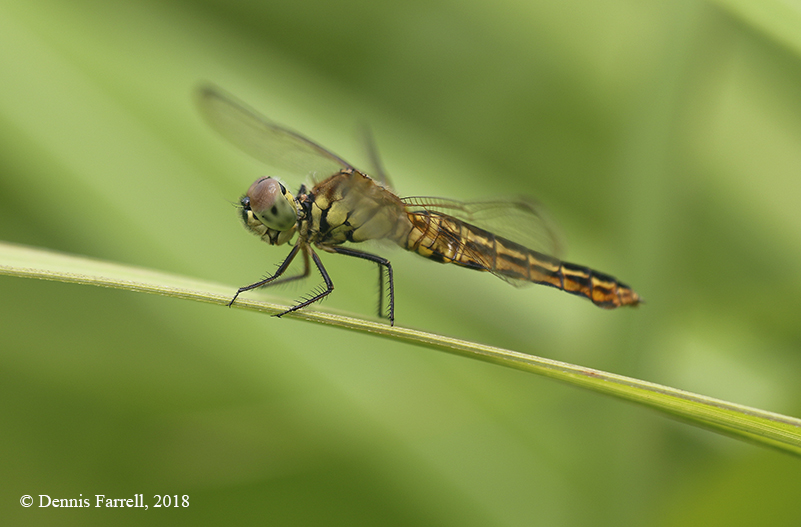
The Female
Upon return, looking for the male once more, I managed to spot a female at the exact location and was happy to let me fire away!


Thursday, July 26, 2018

212: Lyriothemis pallidistigma Kompier, Holden & Makbun, 2021

Number: 212 / Family: Libellulidae / Genus: Lyriothemis
Species: Lyriothemis pallidistigma / Chanthaburi Wide-bellied Dragonfly*
Habitat: Open Grassy Fields
Provinces sighted: Chantaburi
Sightings (by me): Abundant (males and females) at one location
In flight: July
Species easily confused with: Lyriothemis elegantissima, Lyriothemis sp.

*As there isn't a common name, I decided to use part of the Thai name 'Chanthaburi' and there are quite a few names for the genus, such as Bombardier, Skimmer and Chaser. However, I think this genus deserves a more descriptive name so I decided to use a more descriptive 'Wide-bellied Dragonfly' (Lyriothemis: Wide-bellied Dragonfly), which is a more accurate description, so... the Chantaburi Wide-bellied Dragonfly. 

Right at the end of the last day, there was one last location to visit before heading home. Again, we were lead to the location by a fellow dragonfly hunter on Dragonflies of Thailand (Facebook Group). And, yet again, sadly I don't remember their name... but a million thanks anyway! Once we arrived, I was a little shocked. Just like the farmer's paddy field where there were numerous Mortonagrion falactum, this was just a simple field. Seriously, come one. There are millions like it it Khon Kaen. Boring, featureless fields. No way can a rare species reside there. It was a big field, granted, with a lot of long grass. But just a field like any other all the same. However, a female Lyriothemis species had been spotted there and it looked incredibly like L. pachygastra, the male of which I am desperate to see with its awesome blue markings. But I was not confident of seeing anything here. Not a chance. Anyway, there was lots of broken glass in the field and while some of the others put on more suitable footwear, I dived in... within about 5 seconds I came across a female. Amazing! Then a male. Then two more. In fact, they were everywhere! Loads of Lyriothemis out in the open. Why? How? Who? What? What was going on? Who knows? But, there they were, as happy as anything. Within a very short space of time and with everyone well and truly sated with their shots, it was apparent that it wasn't L. pachygastra. It was something else. L. elegantissima was mentioned as was the species I had seen in Phu Khieo, though I wasn't entirely convinced. Upon returning home (and others also collected a few specimens), I began to compare my photos with the ones from PK. The genitalia was slightly different and there were a few other subtle differences. I am convinced it is NOT that species. Then, upon finding Tom's blog (as usual hehe) I notice that he had already posted wonderful photos of L. elegantissima.. it was very similar and found in a similar habitat but, most importantly, the genitalia is almost identical. So, L. elegantissima it was, yay!... though Noppadon still had his doubts ( he always does, haha).  

Since then, this species has now been described as Lyriothemis pallidistigma and is an amazing species.

The Male
Very similar to other red Lyriothemis species but the genitalia and markings are slightly different.


The Female
It is similar to the male but more yellowish in colour, though a few of us saw an orangish female.


A slightly older female...


... and a fully matured female?


...and a young female from a different angle...


Mr and Mrs Lyriothemis... something I saw a few times... the male with the female but not copulating. I wonder why? Copulated already and the male is protecting her? She isn't ready and he is waiting? They are just friends? 

Wednesday, May 9, 2018

198: Lyriothemis cleis Brauer, 1868

No: 198 / Family: Libellulidae / Genus: Lyriothemis
Name: Lyriothemis cleis / Striped Wide-bellied Dragonfly* 
Habitat: Grassy areas near lowlands streams
Province(s) sighted: Narathiwat; Yala
In flight: April
 & August / Sightings (by me): Rare 
Easily confused with: N/A

*As there isn't a common name, I decided to use part of the Thai name 'Chanthaburi' and there are quite a few names for the genus, such as Bombardier, Skimmer and Chaser. However, I think this genus deserves a more descriptive name so I decided to add 'Wide-bellied' to 'Dragonfly' (Lyriothemis: Wide-bellied Dragonflies), which is a more accurate description, so... the Chantaburi Wide-bellied Dragonfly. 

Back in 2008, I was sat having a beer late afternoon and a male Diplacodes trivialis (I had no idea at the time what species it was) plopped right down in front of me. It then flew off and a few moments later, returned to the exact same place now with a small fly in its mouth. Watching it 'ball up' its meal I was transfixed and have never looked back since...


Well, after a full ten years, I have FINALLY got myself 200 photographed species from within Thailand. I have, of course, seen several more but actually getting decent quality photographs that can be used to ID species is another story. Also, by factoring in living in Khon Kaen, being a teacher (so limited budget and very limited time), and doing everything totally by myself (99% of trips have been solo missions, though my brother and a few others have made my trips better in the last few years) is rather impressive if I may say so myself. That's not to say that I haven't had any help... Noppadon Makbun, Oleg Kosterin to name but a few, as well as amazing help from the dragon hunters on Facebook's Dragonflies of Thailand. I could go on, but if I haven't mentioned you, please know that I appreciate the help... and may need it again somewhere down the line. Some of the species are yet to be identified (by science) but I am happy that they are at least separate species. I have a few more to add and a few that I can't add as I simply can't ID them or the angles are all wrong. 


Anyway, onto the 200th species... and a special one to say the least. All Lyriothemis species are rare and hard to locate, even if you know where they are supposed to be. And Lyriothemis cleis also known as the Bombardier is no different. It is a rare species that I was simply incredibly lucky to spot near the waterfall at Hala-Bala WS. However, it didn't all go swimmingly... well, I went swimming to get good shots of Dysphaea dimidiata dimidiata and that seemed to be the killer blow! 


Anyway, as I was waiting around for the birders to turn up I saw a dull red dragon right in front of me. It was perched on a frond in the early morning sunshine which was poking through the tree canopy. I knew what it was straight away but one shot (that didn't come out) and my camera packed up. Aaaarrrggghhhh!!! Dead. Nothing. Now't. I knew the birder gang was about 100 metres away so I had to run to them grab my brother's camera, switch over the lens and then run back... a man had just walked past and it was gone... I was knackered, sweating and pissed off on several counts. No dragon and my camera was dead. I WASN'T giving up. I searched the whole area but it simply wasn't there. However, out came the sun and, with it, came that dull red dragon once more. Now, I was ready... plenty of good shots and it was in the bag. I was soooooooo elated until I walked back to the birder boys who were inspecting my camera... and then the realisation sank in: my dead camera. To cut a long story short, however, 24 hours later it started working again and it was game on again!

The male
The male has a dull red abdomen and also has distinctive yellowish stripes on the abdomen.


The female
Recently, I managed to spot a few more males and was lucky enough to spot a female too in the province of Yala, back in August, 2025.

The female is similar to the male with a dull red abdomen and yellowish stripes on the abdomen. However, I have seen photos of the female looking more orange than red.


194: Lyriothemis biappendiculata (Selys, 1878)

Number: 194 / Family: Libellulidae / Genus: Lyriothemis
Species: Lyriothemis biappendiculata / Black-tipped Wide-bellied Dragonfly
Habitat: Lowland Forested streams  
Province(s) sighted: Narathiwat, Yala
Sightings (by me): Locally common 
In flight (that I have seen): April-August  
Species easily confused with: N/A

*As there isn't a common name, I decided to use part of the Thai name 'Black-tipped' and there are quite a few names for the genus, such as Bombardier, Skimmer and Chaser. However, I think this genus deserves a more descriptive name so I decided to add 'Wide-bellied' to 'Dragonfly' (Lyriothemis: Wide-bellied Dragonflies), which is a more accurate description, so... the Black-tipped Wide-bellied Dragonfly. 

Halfway through the morning of the first full day, my camera packed up. I was gutted, though it was probably my fault (I had been swimming to get a shot) and I think a little water trickled down my wet sleeve and managed to get into the battery compartment (however, it seemed to work later--see full article on Hala-Bala which will be posted shortly). So, one morning was traipsing behind the birder group I was with. It was, of course, interesting as I learnt a little about some of the birds there. However, I was champing at the bit to get on with dragon hunting... way behind my brother, I heard him call out. I ran (well, rather hobbled as 'stiffleg syndrome' had set in from the previous day's walking). Anyway, as I reached him I could already see a solitary red dragonfly perched on a stick at the edge of the path. I knew straight away that it was Lyriothemis sp. and a new one at that for me. However, armed only with a 100-400mm lens and set up for birding getting a shot proved tricky. So, between me and my brother we fired off a few shots and this one was the best that came out. Turns out to be Lyriothemis biappendiculata, male -- a species that I have seen recently in Yala (August, 2025) where both males and females were abundant.

The Male
A beautiful black and red colour that tends to stay motionless for long periods of time (fortunately) and this is often the position you find them along paths that run along streams or hanging above shady swampy ponds.


The Female
This is one of the few species where the female outdoes the male. I like the uniform yellowish brown... but it's those black wingtips and black appendages at the end of the abdomen... awesome! So happy to finally see the female!


Sunday, July 5, 2015

173: Lyriothemis sp.

Number: 173 / Family: Libellulidae / Genus: Lyriothemis 
Species: Lyriothemis sp. / -
Habitat: Exposed Muddy Ponds in Uplands Forested Grassy Areas 
Province(s) sighted: Phu Khieo Wildlife Sanctuary (Chaiyaphum) 
Sightings (by me): Rare     
In flight (that I have seen): July     
Species easily confused with: All Lyriothemis Species

A decent trip to Phu Khieo Wildlife Sanctuary with my brother, Paul, left me with the biggest smile on my face. I had seen a number of dragonflies and a few butterflies whilst on a stakeout to spot the best locations for a longer trip next weekend (to be added). Suddenly at an almost featureless mud hole used by mammals to drink, there was a red dragonfly sitting there, hanging on to the weeds in what seemed like gale force winds. I crept towards it (actually getting stuck in the thick, gooey mud with my attempts) and I realised that it was yet another new species for my records. I managed to get several decent shots even though it was the windiest day in the world, ever! Doing a little research when I got home and it turns out to be Lyriothemis elegantissima (may not be true - see NOTE) - likely a new provincial record and a very rare species to boot. In fact, it is the first time I have seen a specimen from this genus. Amazingly, I even managed to find the female at another location there (I am 99% confident) and tried to photograph it. However, the wind got stronger and stronger and it literally blew the female off the grass and far away! I was gutted, but still happy that I have found the male. Until the next time, female!

NOTE: Since attempting to ID this species, I have come to realise that it may not be L. elegantissima after all. It could be a different species known to Thailand, or even a species yet to be described to science ... so, for safety reasons, I will change it to Lyriothemis sp. for now. Hopefully it can be resolved soon (though I will leave the names on the photos as I am too lazy to do it all again). 


The Female
The female looks like most other females in the genus and so far, I cannot rule this out as being something else, but was in the exact same area as the male above.


This one was hovering above a small pool of water for a short while.