Showing posts with label Rhyothemis. Show all posts

Sunday, March 29, 2026

232: Rhyothemis aterrima Selys, 1891

          Number: 232 / Family: Libellulidae / Genus: Rhyothemis
Species: Rhyothemis aterrima Black Jewel Flutter
Province(s) sighted: Narathiwat
Habitat: Peat Swamp Forest
In flight: August / Sightings (by me): Rare
Species easily confused with: Rhyothemis plutonia 

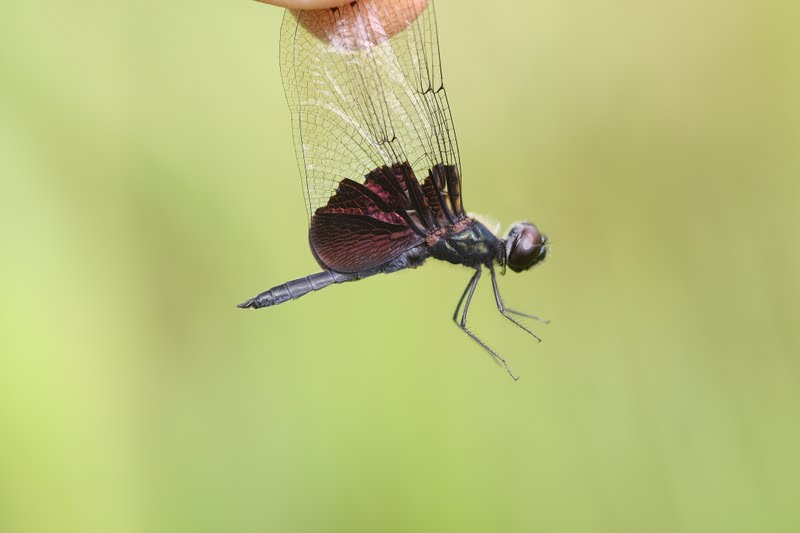
One species that had been reported from Thailand fairly recently but again from the deepest of deep south at Sirindhorn Peat Forest in Narathiwat, was Rhyothemis aterrima, commonly known as the Black Jewel Flutterer. It is well-known in Malaysia so it isn't that much of a surprise to be found here too. However, as with many species, this one also eluded myself and Noppadon Makbun. Frustrated, we gave up on the place and searched other areas in the locality for different species. On the last day in Narathiwat, we decided to take one last look at the place before heading to Yala and see if we could find it as the weather was much hotter and brighter than the previous visit. Opposite the entrance to Sirindhorn, there is a large open area with peat swamp. My brother, Paul, peering through his massive scope for birding saw something interesting... it was bloody R. aterrima but about 100 kilometres away! Maybe I am exaggerating a little but it was way too far out for my 180mm lens, let alone Noppadon's 100mm one. I switched up to 400mm and got a couple of very poor record shots, but at least we had now seen it! We couldn't understand how a few people had decent shots of it if it was so far out, but at the back my mind, one photo that had been taken of it was on wood... the boardwalk? Anyway, we decided to have one last scout around the boardwalks with fading embers of seeing it - and possibly see anything else. Amazingly, we saw another male on the first part of the peat forest but was really, really high up but kept on landing every 30-45 seconds or so. Sadly, this one was also way too high up. So we carried on and went to the second section. Here we saw one straightaway perched rather high on a branch but much lower. We got much better record shots but we were still a little unhappy with them. Finally, another male swooped down from somewhere and started doing the dance around the ponds but much lower, though faster. It then landed straight on the boardwalk... it stayed briefly and then took off... we were gutted. But then, 30-45 seconds later, it landed again on the boardwalk... and again... and again... we edged closer and closer to it as it was incredibly skittish but eventually we got into a decent position and fired off some nice shots as it perched on the bannister of the boardwalk. We couldn't have been happier and the shots really brings out the beautiful colours of this species... when in flight it just looks black.

The Male
From a distance, it just looks black. But on closer inspection (depending on the angle of the light), it's green, copper, reddish, black and even clear segments. It really is a truly stunning species and a fitting species for the last in Narathiwat ... until I return!


Another male OR...
Now, this is specimen I saw a few years back at the lower reaches of Phu Khieo Wildlife Sanctuary in Chaiyaphum. It's about 20 hours' drive from where it is now know in Thailand (Narathiwat - see above). However, this could either be R. aterrima, extending its range massively north or it is something else. There were 2-3 of them at a lowlands pond surrounded by forest. I initially (without thinking) put it down as R. plutonia, but it is clearly not that species. Both Noppadon Makbun and Chee Yen Choong (Malaysian species expert) believe there is no reason for it not to be R. aterrima, which would be an amazing find! Any thoughts?


Sunday, July 17, 2011

130: Rhyothemis obsolescens (Kirby, 1889)

Number: 130 / Family: Libellulidae / Genus: Rhyothemis
Species: Rhyothemis obsolescens Bronze Flutterer
Habitat: Forested Ponds, Lakes and Marshland
Province(s) sighted: Chaiyaphum, Chantaburi, Nakhorn Ratchasima, Petchabun 
Sightings (by me): Locally Common
In flight (that I have seen): June-August

I have just returned from a 2-day trip to Khao Yai National Park. I visited there for the first time, back in April and it was rather quiet, although I did manage to spot one or two new species. This time, however, I faired rather better. Torrential rain, armies of hungry leeches, heavily swollen rivers and inaccessible areas I had previously visited, didn't put me off (though my girlfriend stayed in the rented car most of the time). And it was worth it. I managed to spot a few more specimens, as well as a lot of non-odonata related things and I had a great time. 

I had been driving around Khao Yai National Park all day and right at the death, I noticed a slow-moving, but swollen river about 900 metres up or so. I chanced my arm and drove towards it. I then noticed it was part of a campsite I hadn't even noticed before. There was a beautiful river that ran though it, shrouded by tall, large lilly pads. I saw a few species and decided I needed a full day there and so planned to camp there with my girlfriend in the next few weeks. As I walked back, I noticed something that looked a little like Neurothemis fulvia. Then I realised... it was a species I had been after for a long time, Rhyothemis obsolescens. I followed the male for long periods, trying to get close to it, but it fluttered further along the lilly pads every time. I followed it about 40 metres downstream and then noticed that there were a few more specimens. Almost waist-deep in mud, I managed to get close enough to get a few half-decent photos, much to the amusement of the camping Thais, and the embarrassment of my girlfriend. So, there you have it... all 5 species in the Rhyothemis genus! I couldn't be happier. 

Since then, I have returned and found both male and female and seen this species quite a few times... though I never tire of seeing it!

The Male
From a distance, the male looks much more boring than its cousins. However, on closer inspection, its a vivid bronze with lots of dazzling variants in colour and patterns on its wings. It really is a truly magnificent creature.


In the hand...
I managed to capture a young male. As you can see, they are small, but no less beautiful.


The Female...
The female is identical to the male, except its abdomen is more robust. 


This one has a damaged forewing.


Here is another young female...


Now in hand...this shows just how similar the female is to the male.

Tuesday, July 5, 2011

127: Rhyothemis triangularis (Kirby, 1889)

Number: 127 / Family: Libellulidae / Genus: Rhyothemis
Species: Rhyothemis triangularis / Asian Sapphire Flutterer
Habitat: Exposed Marshland, Ponds and Shallow Lakes (Mostly Uplands)
Province(s) sighted: Chaiyaphum, Petchabun, Nakhorn Ratchasima.
Sightings (by me): Locally common
In flight (that I have seen): April-September
Species easily confused with with: N/A

One of my favourite genus is Rhyothemis and it has just got even better for me. I managed to spot and photograph Rhyothemis triangularis for the first time and it is incredibly beautiful close up. I saw several of the species at the Helicopter Pad lake, Nam Nao. Fortunately for me, the wind was strong, forcing many of species to land and hold onto the grasses and weeds. 
I managed to get very close (the photos are uncropped) to the species and take some photos and I instantly fell in love with it. Although it seems much smaller in real life than I thought, it still looks extremely beautiful. On the second day (with little wind), they resumed their fluttering in the air for long periods, similar to that of the other species in the genus. 
Since then, I visited a number of ponds along the roadside on the way to Nam Nao town (road 2116, I think). At every pond - mostly farmer's ponds - there were one or two present. However, just 1 kms outside Nam Nao town, there was a cluster of ponds/marshland and there were literally hundreds of them! Since then, I have seen this species quite regularly at a number of places and will list all provinces eventually.

The Male
Simply beautiful. That's all I really have to say. It can't be mistaken for any other species. The base of the wings are a bluish purple. The stigma is also the same, as is the thorax and the abdomen.


In hand. The wings are much darker on the underside.


The 'Teneral' Male
On this day, hundreds of specimens emerged, both male and female (see female below) but they were poor fliers. It looks identical to the mature male but looks at those wings glisten!


The Female...
Not only did I see hundreds of males at a marshland, near Nam Nao town, I also saw a few females which only land briefly after copulation.


The 'Teneral' Female
Like with the teneral males (above), the females simply look like the mature females but have that glorious shimmer on the wings.


An amazing thing...
This is another female I managed to capture with my net. As I held her up to photograph her, eggs started pouring out. The difference in time with the below two photos is about 15-20 seconds. When I released her, she flew straight down to the water and dropped them into the water, before flying high back into the treetops. I wonder if the female can't stop producing/releasing eggs, once she has started.


The copula...
I even managed to spot and photograph a copula (though not the best photo in the world). Bear in mind that they always land deep in the rushes and it only lasts for a few seconds, then they split. So, not a bad effort really.

Tuesday, April 26, 2011

117: Rhyothemis plutonia (Selys, 1883)

Number: 117 / Family: Libellulidae / Genus: Rhyothemis
Species:  Rhyothemis plutonia Greater Blue Wing Flutterer*
Habitat: Exposed Weedy Marshland (Warm Water), Ponds and Lakes (Lowlands to Uplands)
Province(s) sighted: Widespread
In flight: April-July / Sightings (by me): Locally Common
Species easily confused with: Rhyothemis aterrima

*The given common name is the Great Blue Wing, but I have added 'Flutter' to be consistent with other species in the genus, so the Great Blue Wing Flutterer.

FINALLY! I managed to capture photos of this species. I had seen a solitary male twice before, but they continually flew high above the treetops giving me no hope of photographing them. Then, at a tiny pond/marshy area with warm water, I saw two males fighting each other. After each battle they would land back in the same position. They did this over and over again. Eventually, I crept down some steep banking and through the marshy area. I got it! In fact, these are completely uncropped and I was amazed how they didn't just fly away. So there it was, my 3rd species from this genus, Rhyothemis plutonia. Since writing this blog I have seen this species all over the country. It is seemingly very common but still very beautiful.

The Male
Simply stunning is the best way to describe this species. It is almost completely black, but has sparkling metallic green and pink/orange colouration to the wings, which gives it its name.

These are the best natural photos I have managed so far. 


This one I caught recently at Nam Nao... it had just been in a battle with another male, hence the damaged wing. 


The Female...
Unlike the few others I have seen (mostly as part of a copula that lasts for a few moments), she sat there happily, letting me get close to her (though it was windy and she was hanging on I think). These photos are uncropped. The female is the same as the male, but the abdomen is more robust. Also, she seems to have more green colouration to her wings and no pink, though this could vary.


Sunday, February 27, 2011

32. Rhyothemis variegata phyllis (Sulzer, 1776)

No: 32 / Family: Libellulidae / Genus: Rhyothemis
Name: Rhyothemis variegata phyllis / Yellow-striped Flutterer 
Habitat: Exposed Areas, Near or at Ponds/Lakes and Slow Streams (Often Fly in Swarms High Up)
Province(s): Widespread
In flight: April-November / Sightings (by me): Very Common
Easily confused with: N/A

There are 5 Rhyothemis species of dragonfly and I have so far only seen 2 in Khon Kaen.  The female of Rhyothemis variegata phyllis is very common. They tend to flutter and could easily be mistaken for a butterfly. They are often seen fluttering for long periods of time and only land for brief moments.

The Male
After two years of searching I finally managed to capture a decent photo of the male - now I can spot them more easily. 


Some males have fewer spots.


The 'Andromorph' Form Female
This 'andromorph' female is hardly ever seen and only have one or two photos of it.


The 'Gynomorph' Female
This female is very common and if you are lucky will land right in front of you.


You can see this species throughout the country most of the year and is a beautiful species.