Number: 127 / Family: Libellulidae / Genus: Rhyothemis
Species: Rhyothemis triangularis / Asian Sapphire Flutterer
Habitat: Exposed Marshland, Ponds and Shallow Lakes (Mostly Uplands)
Province(s) sighted: Chaiyaphum, Petchabun, Nakhorn Ratchasima.
Sightings (by me): Locally common
In flight (that I have seen): April-September
Province(s) sighted: Chaiyaphum, Petchabun, Nakhorn Ratchasima.
Sightings (by me): Locally common
In flight (that I have seen): April-September
Species easily confused with with: N/A
One of my favourite genus is Rhyothemis and it has just got even better for me. I managed to spot and photograph Rhyothemis triangularis for the first time and it is incredibly beautiful close up. I saw several of the species at the Helicopter Pad lake, Nam Nao. Fortunately for me, the wind was strong, forcing many of species to land and hold onto the grasses and weeds.
I managed to get very close (the photos are uncropped) to the species and take some photos and I instantly fell in love with it. Although it seems much smaller in real life than I thought, it still looks extremely beautiful. On the second day (with little wind), they resumed their fluttering in the air for long periods, similar to that of the other species in the genus.
Since then, I visited a number of ponds along the roadside on the way to Nam Nao town (road 2116, I think). At every pond - mostly farmer's ponds - there were one or two present. However, just 1 kms outside Nam Nao town, there was a cluster of ponds/marshland and there were literally hundreds of them! Since then, I have seen this species quite regularly at a number of places and will list all provinces eventually.
Since then, I visited a number of ponds along the roadside on the way to Nam Nao town (road 2116, I think). At every pond - mostly farmer's ponds - there were one or two present. However, just 1 kms outside Nam Nao town, there was a cluster of ponds/marshland and there were literally hundreds of them! Since then, I have seen this species quite regularly at a number of places and will list all provinces eventually.
The Male
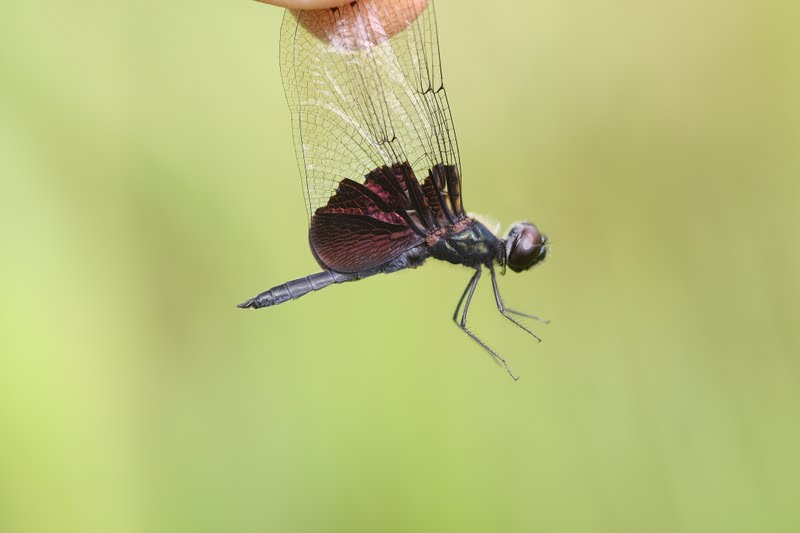
Simply beautiful. That's all I really have to say. It can't be mistaken for any other species. The base of the wings are a bluish purple. The stigma is also the same, as is the thorax and the abdomen.

In hand. The wings are much darker on the underside.
The 'Teneral' Male
On this day, hundreds of specimens emerged, both male and female (see female below) but they were poor fliers. It looks identical to the mature male but looks at those wings glisten!

The Female...
Not only did I see hundreds of males at a marshland, near Nam Nao town, I also saw a few females which only land briefly after copulation.


The 'Teneral' Female
Like with the teneral males (above), the females simply look like the mature females but have that glorious shimmer on the wings.

An amazing thing...
This is another female I managed to capture with my net. As I held her up to photograph her, eggs started pouring out. The difference in time with the below two photos is about 15-20 seconds. When I released her, she flew straight down to the water and dropped them into the water, before flying high back into the treetops. I wonder if the female can't stop producing/releasing eggs, once she has started.


The copula...
I even managed to spot and photograph a copula (though not the best photo in the world). Bear in mind that they always land deep in the rushes and it only lasts for a few seconds, then they split. So, not a bad effort really.


you can see R. obsolescens in the Krating waterfall, Chantaburi, in this season. I saw lots of it there between May-July.
ReplyDeleteThanks, Noppadon. I hope to go back there very soon indeed and will look out for it. I'd love to see all five species from the genus.
ReplyDeleteKeep up the fantastic work! Cheers, Dennis