Monday, July 13, 2015

174: Platylestes platystylus (Rambur, 1842)

Number: 174 / Family: Lestidae / Genus: Platylestes  
Species: Platylestes platystylus / Green Spotted Spreadwing*
Habitat: Forested Marshy Lakes 
Province(s) sighted: Chaiyaphum  
Sightings (by me): Rare / In flight: July-November 
Species easily confused with: Lestes praemorsus decipiens; Lestes elatus

*As there is no common name, I have used the first part of the Thai nam 'Green Spotted' and the commonly used name for the genus, 'Spreadwing, so it is 'Green Spotted Spreadwing. 

Well, things just seem to be going well for me this year. Another trip to Phu Khieo Wildlife Sanctuary in Chaiyaphum yielded yet another species for me ... this time in the shape of Platylestes platystylus. It is a species that I have been searching for now for a long time (I think I saw it once in Chiang Mai and the search was on from then). Every time I thought I saw it, on closer inspection it turned out to be either L. decipiens or most often L. elatus. It is clearly an uncommon species but even more so in NE Thailand (but then most things are). I decided to search an area I visited last October, which is an extremely claggy and marshy area that is difficult to walk through and even though I nearly died of exhaustion, it was well worth it. There deep in the reeds was another specimen from the Lestidae family ... surely ... it was ... yes! Finally, I saw it and got a few decent photos though the wind was terrible and made photographing twig-sized bugs on reeds rather challenging indeed. I managed to spot 4-5 males in a small area and was also extremely happy to not only spot, but get some great shots, of the female 'in action'. I have since seen another two males and a single young male.

The Male
The male is a blueish-olive colour and quite pale compared to other similar species. It also has a number of small spots on the thorax which is characteristic of the species. However, for a proper identification, you need to look at the white appendages, which are quite different from other Lestid species. 


The 'Teneral' Male
Here is a newly emerged male early in the morning. Probably emerged overnight. Here, it displays all the markings very well.


The Appendages


The Female
The female is very similar to the male but is slightly paler olive green, has fewer spots and its abdomen is more robust, which is typical of this family. Here, she is ovipositing (laying eggs).


The Copula


... and in tandem ... 

but what's happening?


Sunday, July 5, 2015

173: Lyriothemis sp.

Number: 173 / Family: Libellulidae / Genus: Lyriothemis 
Species: Lyriothemis sp. / -
Habitat: Exposed Muddy Ponds in Uplands Forested Grassy Areas 
Province(s) sighted: Phu Khieo Wildlife Sanctuary (Chaiyaphum) 
Sightings (by me): Rare     
In flight (that I have seen): July     
Species easily confused with: All Lyriothemis Species

A decent trip to Phu Khieo Wildlife Sanctuary with my brother, Paul, left me with the biggest smile on my face. I had seen a number of dragonflies and a few butterflies whilst on a stakeout to spot the best locations for a longer trip next weekend (to be added). Suddenly at an almost featureless mud hole used by mammals to drink, there was a red dragonfly sitting there, hanging on to the weeds in what seemed like gale force winds. I crept towards it (actually getting stuck in the thick, gooey mud with my attempts) and I realised that it was yet another new species for my records. I managed to get several decent shots even though it was the windiest day in the world, ever! Doing a little research when I got home and it turns out to be Lyriothemis elegantissima (may not be true - see NOTE) - likely a new provincial record and a very rare species to boot. In fact, it is the first time I have seen a specimen from this genus. Amazingly, I even managed to find the female at another location there (I am 99% confident) and tried to photograph it. However, the wind got stronger and stronger and it literally blew the female off the grass and far away! I was gutted, but still happy that I have found the male. Until the next time, female!

NOTE: Since attempting to ID this species, I have come to realise that it may not be L. elegantissima after all. It could be a different species known to Thailand, or even a species yet to be described to science ... so, for safety reasons, I will change it to Lyriothemis sp. for now. Hopefully it can be resolved soon (though I will leave the names on the photos as I am too lazy to do it all again). 


The Female
The female looks like most other females in the genus and so far, I cannot rule this out as being something else, but was in the exact same area as the male above.


This one was hovering above a small pool of water for a short while.

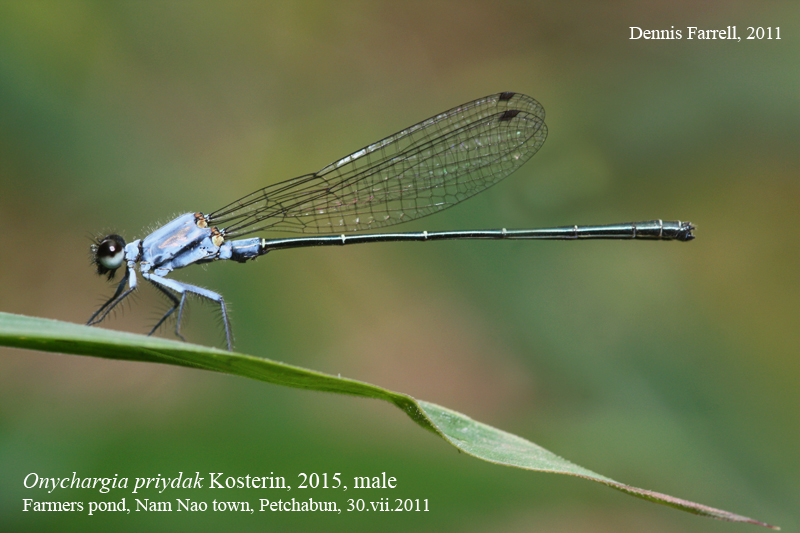
172: Onychargia priydak Kosterin, 2015

Number: 172 / Family: Platycnemididae / Genus: Onychargia 
Species: Onychargia priydak White-chested Dancer 
Habitat: Uncertain (I saw it at an upland farmer's pond during a storm) 
Province(s) sighted: Petchabun
Sightings (by me): Rare   
In flight (that I have seen): July   
Species easily confused with: N/A

So, the day after spotting a new species at school yesterday, I managed to spot another rare species, all from the comfort of my living room ... I think I may stop looking! A species I had photographed a good few years ago has finally been separated from Onychargia atrocyana. Onychargia priydak, is a species that looks like O. atrocyana, but differs superficially and is easily distinguished by having heavy white pruinesence on the thorax instead of the usual purplish-black. It has just been described by the amazing Oleg Kosterin, who described the species from Cambodia. Anyway, it is also present in Thailand and I believe in Hong Kong as well ... so if you come across a white wisp floating around take a closer look, you never know. 


171: Asiagomphus xanthenatus xanthenatus (Williamson, 1907)

Number: 171  / Family: Gomphidae  / Genus: Asiagomphus 
Species: Asiagomphus xanthenatus xanthenatus / - 
Habitat: Forested Streas 
Province(s) sighted: Kaeng Krachan 
Sightings (by me): Rare 
In flight (that I have seen): April   
Species easily confused with: All Gomphids

Whilst visiting Kaeng Krachan, I managed to spot a number of species I had come across before. I must admit that I was somewhat disappointed and ended up concentrating on butterflies. No idea why, but I could have been a few weeks early for the rarer species. That said, as I was about to cross one of the streams that cross the road, a Gomphid landed momentarily. I managed only a record shot before it, too, shot off. I researched it when I returned home and I was confident it was Asiagomphus xanthenatus xanthenatus, confirmed later by Noppadon Makbun. So I did get a new species after all, but it was a poor shot ... until the next time we meet!


The Female
Sightly better shot than the male but not that much, this was a good distance away and I managed to firs toff two shots before some annoy little s... I mean lovely little boy, threw a ball near it and it flew away! I had this down as a completely different species for a long time but was corrected on it recently (rightly so), by Noppadon Makbun. You know when you have a species locked in and someone says.... "naaaa"... you fight tooth and nail to keep it but I always lose haha. Thanks for the ID Noppadon!


I really must go back and try to get good shots... these really are rubbish!
 

Tuesday, June 30, 2015

170: Macrogomphus matsukii Asahina, 1986

Number: 170  / Family: Gomphidae  / Genus: Macrogomphus 
Species: Macrogomphus matsukii  / Matsuki's Giant Tiger 
Habitat: Uncertain (though believed to be lowland forest areas) 
Province(s) sighted: Khon Kaen, Roi Et, Sakhon Nakhon
 Sightings (by me): Rare 
In flight (that I have seen): June-July  
Species easily confused with: All Macrogomphus Species

*As there is no common name, I decided upon 'Matsuki' based on the author's honour and Macrogpmphus in Thai are known as  'Giant Tiger Dragonflies' so I kept that for consistency.

Though it may not seem like it, I have been busy searching for new odonates for a while and it has been rather futile. Khon Kaen in still exceptionally dry, especially as we should be well and truly into the rainy season by now. Every trip (several to Phu Wiang, Nam Phong and once to Nam Nao) has yielded very little. To the point, every trip seems to turn into a butterfly trip instead (I do like photographing them too). Today, though, things changed for the better ... and I was actually sat at my desk at school. A work colleague came in and informed me that a large black and yellow dragonfly had crash-landed into a massive window in the school corridor. I dashed out thinking it would be Ictinogomphus decoratus melaenops. Yet, no, it wasn't. I could see it was a new species straight away though wasn't entirely sure. I caught him with my fingers and later on I took photos of him, before releasing him again. By then, I was confident that it was Macrogomphus matsukii, a new species for Khon Kaen and another species for my record list. So, I am certainly a happy camper right now. Still, I can't help but wonder whether it was just passing through Khon Kaen as there isn't a stream, forest or even a pond for a good distance from school. Only he really knows ... unless I find a new place with several specimens one day. Watch this space. 
Resting just after release. I had to be quick as it was going dark and he flew away about 30 seconds later. I have since seen this at the local River Chi in Khon Kaen and also at a shallow sandy stream in Sakhon Nakhon province, as well as a solitary male in Roi Et, but it is not common.  


Being photographed close up ...


... and his appendages close up.


The Female
I was lucky enough to spot a female at the River Chi, Choonabot, Khon Kaen, in 2019.


Saturday, January 31, 2015

169: Indolestes anomalus Fraser, 1946

Number: 169 / Family: Lestidae / Genus: Indolestes
Species: Indolestes anomalus / Spotted False Spreadwing*
Habitat: Forested Ponds
Province(s) sighted: Chaiyaphum, Petchabun)
Sightings (by me): Locally Common
In flight (that I have seen): January - August
Species easily confused with: All Indolestes Species

*As this species has no common name, I have based it on being location-based 'Spotted Thorax' and Lestidae are known as 'Spreadwings'. However, this genus distinctly keeps its wings closed. Therefore, I arrived at 'False Spreadwing' which still tips its hat towards Spreadwings, so the Spotted False Spreadwing.

Yesterday, I went on a short trip along with my brother, Paul, who was birding. We took in the usual Helicopter Pad Lake which was decidedly quiet. Then moved onto a few trails within Nam Nao National Park. Again, it was seriously quiet, though I did spot a few nice butterflies (which I will soon be posting on my new website (which can be seen here). The trail was around 4-5 kms, though it seemed longer. There were a few ponds and drying puddles along the way, one which housed several Lestes elatus and a surprisingly large number of Ceriagrion olivaceum. Surprising as it is the first time I have seen this species within Nam Nao. At the end of the trail was a larger pond in an opening and was surrounded by reeds. Quietly making my way through the reeds, I saw a very small and dark teneral specimen. Though it was hard to see in blazing sunshine, I could see that it was a female and that it was something different and the end segments were enlarged. I closed in and took a few photos. I knew straight away that it was Indolestes. And the only species from that genus I hadn't seen was Indolestes anomalus. I then saw a solitary male which looked very much like Indolestes birmanus ... and doubt started to creep in. It wasn't until I returned home that I could say confidently that it was indeed I. anomalus, and has been confirmed by Noppadon Makbun, who said he saw this species at Nam Nao in June - possibly at the same place. So, though quiet, I was jumping for joy at spotting a rare species and completing the known Indolestes species of Thailand ... unless I can find another! I will return in March or April in search of fully-mature specimens, which I believe are a blueish colour, similar to Indolestes inflatus, which I discovered at the large lake before.

NOTE: Since first recording this species, I have returned to the same location where I saw literally hundred of specimens and copula at every pond along the trail. Additionally, I managed to spot a healthy number of specimens at Phu Khieo Wildlife Sanctuary on my last trip (21.v.16). It is also rather common at Nam Nao National Park in Petchabun.

The Male
The blue males really is like all others in the genus in Thailand (currently four), but it is easy to separate due to having spots on the thorax. 


Teneral male


 The Female 
Similar to the male, but dull and boasts bulbous end segments which gave away the ID


Mature female ovipositing (laying eggs)


Teneral female


The Tandem
I just love this image from very early in the morning, with the light and the spider's web... oh, yeah and the subject! One of my favourite shots.


Some more tandems (yes, a randy species)...


The Copula (Wheel)
Though I see tandems and ovipositing quite regularly at the right time of year, the wheel is rare to see.


How many holes can you make in a stem?


... a lot more if you team up.