Location 1: Helicopter Pad Lake, Nam Nao National Park, Petchabun.
Date: Saturday, 8th September, 2012.
Weather: Heavily overcast, torrential rain, swampy conditions
Weather: Heavily overcast, torrential rain, swampy conditions
Expectations of recording additional species (for my list): zero
Leech bites: 8
I think a band called Wet Wet Wet once released a song titled, Sweet Little Mystery (how sad of me to remember that) ... well, yesterday (and the previous month for that matter) was certainly wet. Unfortunately, there was no sweet little mystery to be found. I made two visits in August. The first one was abandoned whilst riding there on my motorbike, as the torrential rain started seeping into my camera bag and I can't afford to replace my equipment. It was also getting a little dangerous riding my scooter in such conditions. The second trip, I was lucky enough to borrow my brother's car. However, sitting at the watchtower of the Helicopter Pad lake simply watching the rain pour down from 6.00 a.m. - 2 p.m. wasn't exactly the highlight of my project. Only the resident spiders seemed unaware of the weather. Alas, no blog page for August (attempts were made on 18/08 and 25/08). Still, onwards and upwards. I did manage to borrow my brother's bike again yesterday - and I was lucky too as it was rain, rain, rain yet again. This time, however, there were breaks in the rain and I think I even saw the sun once or twice.
Yet, to say it was quiet walking around the lake is an understatement. Nothing, and I mean nothing, was actively taking to the air. OK It was early and it had been pouring it down, but I thought that there may have been something. Then I think I saw why ... everything was hiding - probably shivering - in the now extremely tall grasses and reeds. All specimens were soaked. They clearly had no power to move. This, however, gave me an opportunity to photograph a few of the more common species. I trudged around the lake, spotting common species as I disturbed them from their slumber. Every 5 minutes or so, I had to cover my camera as the rains returned. Each time it stopped, I continued. I did manage to spot a large monitor lizard in the lake, which is something I have never seen there before. I continued, but to no avail. Only common species appeared, even trudging - almost dragging myself - though the extremely tall and dense reeds.
From the last visit, Pseudothemis jorina, Indolestes inflatus, Prodasineura auricolor and Agrionoptera insignis were not present. However, Ceriagrion indochinense, Ictinogomphus decoratus, Orthetrum sabina sabina had returned (though probably never been away - just hiding away last time). Also, solitary males of Aciagrion borneense appeared for the first time this year. Pseudagrion australasiae and I returned to the car somewhat unhappy with the day, and even questioned visiting the stream. However, once I had dried off a little, had a coffee and looked at some of the photos I had taken, my second wind hit me ... and I'm glad that it did!
Some of my best photos at the lake ...
Ictinogomphus decoratus, teneral male - welcome to the world ... of misery. Newly emerged and soaked through. Not the best possible start.
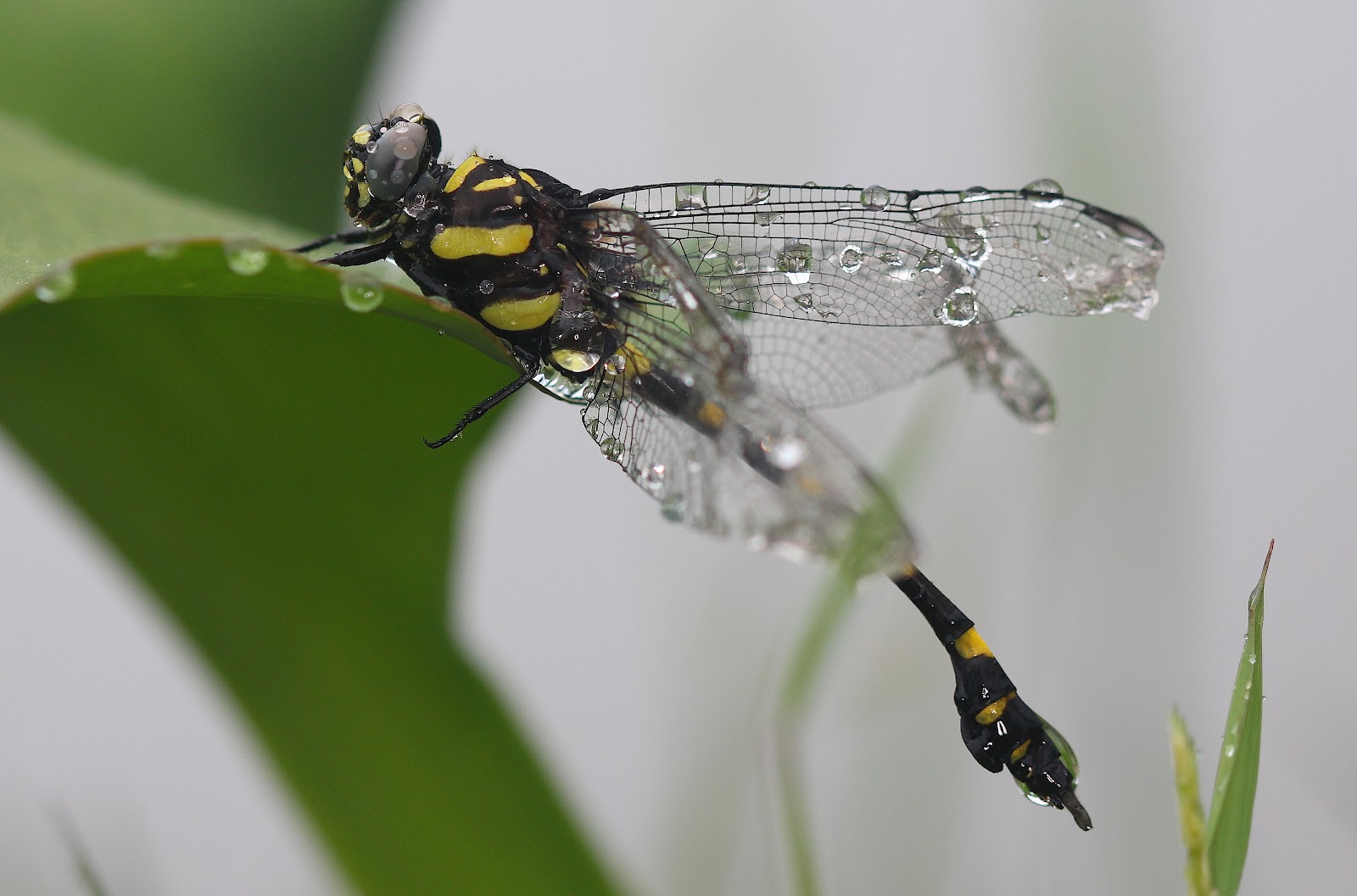
Even a little hopper used him as cover from the rain.


Indothemis limbata, male


Trithemis aurora, male

Pantala flavescens, female

Trithemis aurora, teneral male

Indothemis limbata, teneral male

Aciagrion borneense, male

Argiocnemis rubescens rubeola, female

Rhodothemis rufa, teneral male (kindly ID'd by Oleg Kosterin)


Many thanks to Oleg for clearing up my confusion between Orthertrum chrysis and Rhodothemis rufa males at the teneral stage.
Nam Nao Helicopter Pad (added species from the last visit, bold; new species for the lake, blue; species not seen from last visit, red)
Note: Numbers were low/absent common species probably due to the heavily overcast/monsoon conditions.
Fam. Coenagrionidae
Aciagrion tillyardi (Laidlaw, 1919) ♂ ♀ [common]
Aciagrion borneense (Ris, 1911) ♂ [1]
Agriocnemis femina (Brauer, 1868) ♂ ♀ [very common]
Agriocnemis nana (Laidlaw, 1914) ♀♂ [common]
Agriocnemis pygmaea (Rambur, 1842) ♂ [1]
Argiocnemis rubescens rubeola (Selys, 1877) ♂♀ [2 each]
Ceriagrion indochinense (Asahina, 1967) ♂ [fairly common]
Ischnura senegalensis (Rambur, 1842)
Onychargia atrocyana (Selys, 1865) ♂ ♀ [common]
Pseudagrion australasiae (Selys, 1876) ♂ [1]
Pseudagrion rubriceps rubriceps (Selys, 1876) ♂ [2]
Fam. Lestidae
Indolestes inflatus
Fam. Platycnemididae
Coeliccia chromothorax (Selys, 1891) ♂ [2]
Copera ciliata (Selys, 1863) ♂ ♀ [extremely common]
Copera marginipes (Rambur, 1842) ♂♀ [common]
Fam. Protoneuridae
Prodasineura autumnalis (Fraser, 1922) ♂ ♀ [extremely common]
Prodasineura auricolor
Fam. Gomphidae
Ictinogomphus decoratus (Selys, 1854) ♂ [1 teneral]
Fam. Libellulidae
Acisoma panorpoides panorpoides (Rambur, 1842) ♂ ♀ [common]
Agrionoptera insignis (Rambur, 1842)
Brachydiplax farinosa (Krüger 1902) ♂ ♀ [♂ common]
Agrionoptera insignis (Rambur, 1842)
Brachydiplax farinosa (Krüger 1902) ♂ ♀ [♂ common]
Brachythemis contaminata (Fabricius, 1793) ♂ ♀ [common]
Crocothemis servilia (Drury, 1773) ♂ ♀ [fairly common]
Diplacodes trivialis (Rambur, 1842) ♂ ♀ [fairly common]
Indothemis limbata (Selys, 1891) ♂ [♂ common]
Rhodothemis rufa (Rambur, 1842) ♂ [1 teneral]
Orthetrum sabina sabina (Drury, 1770) ♂♀ [fairly common]
Pseudothemis jorina Förster, 1904
Tholymis tillarga (Fabricius, 1798) ♂ [1]
Trithemis aurora (Burmeister, 1839) ♂ ♀ [extremely common]
Location 2: Stream at the Heaquarters, Nam Nao National Park, Petchabun.
Date: Saturday, 8th September, 2012.
Weather: Heavily overcast with monsoon conditions
Weather: Heavily overcast with monsoon conditions
Expectations of recording additional species (for my list): medium
Leech bites: 0
Once I had arrived at the stream, I was hoping to spot a new species or two, but didn't expect anything. The stream was up about 6 inches and chocolate brown compared to that of my last trip. However, my spirits - though dampened by the weather - were still fairly high. In fact, there were one or two common damselflies buzzing around in a bright opening (which didn't last long). I also saw a male Zygonyx iris malayana, darting around at an amazing speed - even for that species! Within a few metres of the entrance I was amazed to see another Rhinagrion hainanense (kindly confirmed by Oleg!). This was about 5-600 metres from where I saw the last one. He was perched on a branch about 0.5 metres above the stream. He wasn't easily scared and I was able to get fairly close to him. If I did disturb him, he would simply fly to a stump close by which had a large hole in it. He would search around the area then return. Eventually, I continued as did the rain. Most of the common species that were around had now disappeared. However, I was amazed to find a second R. hainanense and then another and another ... 4 to be precise. All about 10-20 metres apart. Sometimes they would come into contact with each other and have a little dance. I made my way along the stream, but it was getting darker and darker - those big clouds were looming. As the clouds approached, I too neared the area where I had spotted a good number of species on my last trip - including my first encounter with Rhinagrion hainanense at Nam Nao. I approached the same tree that spanned the stream, where I had spotted a male. As I neared I disturbed a male Merogomphus paviei and noticed a male Gomphidictinus perakensi perching above my head near the log. The water was still shallow enough to wade through and as I prepared myself to do so, I noticed yet another male Rhinagrion hainanense. I photographed him and then reached the log. I noticed another male sitting on the log (now broken and had moved slightly probably due to an earlier storm). I hoped to see a female ... and as if by magic a female appeared from nowhere ... but then flew up slightly into the air. By doing this, she disturbed all the males and about 5-6 males from all areas appeared, one in particular followed her and hovered near her, arching his abdomen under his thorax to reveal his bright orange/red underside. A fleeting glimpse, but a female all the same. The weather was about to turn nasty. I was about to head back for the car, when I impulsively looking under the log - and there, I thought, was another female. The specimen was right under the log (which was about 12 inches above the water. Worse, it was at the fork of the log, so getting my camera anywhere near it was really tough. I was stood in the middle of the stream pondering my next move. I managed to feed the camera inside the fork of the log and, using the monopod just about got a few decent photos, though the flash didn't go off the first time. Indeed it was a female ... and she was ovipositing. I tried for around 20 minutes to get good photos, moving around from different angles. Unfortunately, she was in the most difficult place possible. I decided just to watch her. She continued for another few minutes, moving slowly around the underside of the log. Then another female turned up, and also started moving downwards into a similar position. Unfortunately, she didn't like my presence and flew into the branches above my head ... too high to take a photo. Eventually the first female finished and flew out of the log and onto a branch. She, too, was out of reach of my camera, but not my fingers! I managed to grab her wings. I managed to get a few good photos of her before the heavens opened. I dived for cover under a tree but the rain got harder and harder. I decided it was time to leave. I passed the 2nd female I had seen and she was still hanging on to a branch even though she was getting battered by the rain.
I tried to return to the car park, yet the pathway had too become a stream. Soaking wet, I made it back to the car. It was only 2.00 p.m. so waited in hope that the rain would abate. Eventually, it obliged so I set off again. This time, however, the stream was more like a raging torrent of a river - it had risen about 12 or so inches in about 1 hour. I still made it back to the areas where the females were and I couldn't get near it - the stream was now licking at the base of the log ... maybe that was why the females were so active.
So, not much in terms of new species. Yet, it turned out to be a great day watching the female at work.
My best photos of the day:
Rhinagrion hainanense, male ... the 2nd I have seen at this stream.

... and another

Now in the hand, he played dead.

Phwoah! That's what the females must think anyway. The male arches his abdomen under his thorax to reveal his colours when a female is present ... a bit like a scally with a pimped-up car, I suppose.

Here's the same log that I saw the male for the first time in July. The water is higher now and coloured.

Right at the base of the log and in the most awkward position ever, I could see a shadow ...

... and when the flash decided to work, the female was revealed - now with the blade of the ovipositor fully buried.

I managed to get my camera in front of the branch blocking my view and this was the best I could get.

Now in the hand ... what a beautiful thing she really is.


Nam Nao Headquarter's stream (added species from the last visit, bold; new species for the stream, blue; species not seen from last visit, red)
Family: Chlorocyphidae
Rhinocypha biforata (Selys, 1859) ♂ ♀ [very common]
Family: Euphaeidae
Euphaea ochracea (Selys, 1859) ♂ ♀ [♂ common]
Family: Megapodagriondae
Rhinagrion hainanense (Wilson & Reels, 2002) ♂♀ [♂ 10-12, ♀ 2]
Rhinagrion hainanense (Wilson & Reels, 2002) ♂♀ [♂ 10-12, ♀ 2]
Family: Gomphidae
Gomphidictinus perakensi (Laidlaw, 1902) ♂ [1]
Merogomphus paviei (Martin, 1904) ♂ [1]
Family: Platycnemididae
Coeliccia didyma (Selys, 1863) ♂ [common]
Coeliccia c.f. loogali (Fraser in Laidlaw, 1932) ♂ [common]
Copera marginipes (Rambur, 1842) ♂ ♀ [very common]
Copera marginipes (Rambur, 1842) ♂ ♀ [very common]
Copera vittata (Selys, 1863) ♂ ♀ [common]
Family: Protoneuridae
Prodasineura auricolor
Family: Libellulidae
Zygonyx iris malayana (Selys, 1869) ♂ [1]


