Saturday, June 11, 2011

124: Orolestes octomaculatus (Martin, 1902)

Number: 124 / Family: Lestidae / Genus: Orolestes
Species: Orolestes octomaculatus / Large Eight-spotted Spreadwing*
Habitat: Forested Ponds (Mostly lowlands)
Province(s) sighted: Chaiyaphum, Khon Kaen, Nakhon Nayok, Petchabun, Udon Thani
Sightings (by me): Common
In flight (that I have seen): Year-round

*As it didn't have a common name, I based the name on the Thai name 'Large Eight-spotted' and the common name for Lestidae 'Spreadwings', so the 'Large Eight-spotted Spreadwing'.

A spreadwing that is widespread (that's a mouthful!), and quite common and had eluded me until now, is Orolestes octomaculatus, now known as the Large Eight-spotted Spreadwing. I saw a male for the first time on June 11, 2011. However, today (June 18, 2011) I returned to find the female. Where I had seen three males at Tad Fah Waterfall, this time there was only one and I thought my luck was out. So I decided to visit Phu Wiang National Park itself about 20 kms away from the waterfall. About 300 metres inside the entrance there was a tiny and muddy clay pool to my left with a few bushes and trees overhanging and I thought I may as well have a look, seeing as though I was there already. To my amazement, there were around 20 male O. octomaculatus resting out of the sun under the leaves of a small tree. I managed to improve my photos from the previous week (though it took a long time as they fly high up into the tree the moment you even breathe) and then tried to take even more shots (sometimes I'll take hundreds of photos of the same individual just to make sure it's OK). As I was about to shoot again, I noticed something above it on the same branch... I took a photo just to see what it was and it turned out to be a female! Yet, it was in the strangest position I have ever seen. Watching her for about 20 minutes, I discovered she was ovipositing into the bark of the tree that overhung the pond. Since then, I have seen this species many times at numerous different locations and it appears to be around the whole year.

The Male
It is easy to distinguish because of its beautiful wings, blue/green eyes and S9-10 are bright blue and it has large claspers. It is also large for a damselfly.


Here's looking at you ... 


The 'Hyaline' Male
A small number of males never develop black spots on their wings (and young males too) and are known as hyaline specimens. This is not commonly seen.


The 'Young' Male
This is a very young male...


...and this one has literally just emerged...


The Female
The female is fairly dull in comparison, but she does have a blue dorsal patch at the end of the abdomen.


This female is ovipositing into a branch. Something I see quite a lot with this species.


And here is another...


The 'Teneral' Female
You rarely see then at this stage but then suddenly they will emerge en masse.


Another emergence very early and still attached to her exuvia. Don't know why but this is right up their for favourite shots. I captured this well in the early morning light, even if I may say so myself.


The Copula
It took me a long time to get this and it is rarely seem! I was very happy with it, but somehow I much prefer the shot after where they are both resting momentarily. There is just something about this I love.


The Tandem


The Courtship/Mating Behaviour
Here, I just managed to get a blurry photo as the male grabs a female.

He now has her firmly.


Let the mating begin...


Once split, she starts to use her ovipositor to gouge out small holes in the branches and lay single eggs into each hole... all the while, the male is guarding his prize.


A second male appeared, and shortly (off camera, the first male attacks the second and it disappears.

Thursday, June 9, 2011

123: Pseudagrion australasiae Selys, 1876

Number: 123 / Family: Coenagrionidae / Genus: Pseudagrion
Species: Pseudagrion australasiae / Look-alike Sprite
Habitat: Exposed Ponds, Lakes & Slow-moving Streams (Uplands & Lowlands)
Province(s) sighted: Widespread
Sightings (by me): Common
In flight (that I have seen): April-December
Species easily confused with: Pseudagrion microcephalum; Cercion malayanum;

One species that I'm sure I have seen a number of times is Pseudagrion australasiae. However, unless you are very, very close to it, it is hard to tell the difference between P. australasiae and P. microcephalum. Having studied photos for a long time, one difference I have noticed (I think) is that P. microcephalum is a brighter, more vivid blue. Whereas P. australasiae is a slightly more muted blue. Also, P. australasiae is slightly bigger but has shorter caudal appendages compared to that of P. microcephalum. 

The Male
As mentioned above, the male is very similar to the male of P. microcephalum. If you see two together, it is easier to compare as P. australasiae is duller in colouration and is also larger. Also, P. microcephalum is far more common in Khon Kaen and the surrounding areas. 


The 'Young' Male
This is a very young male and hasn't developed the blue colour.


The 'Youngish' Male
This male is almost fully mature but not quite.


P. australasiae is slightly larger than P. microcephalum (a good way of IDing if seen together)


The superior (top) appendages are shorter than those of P. microcephalum


The Female...
The female is very similar to other females in the genus. However, for me, I was lucky recently. At at large, shallow lake I saw recently at Khao Yai, Nakhon Ratchasima province, I spotted many males and females, including the female at all stages. P. microcephalum wasn't present, making identification easier. 


The 'Old' Female...
This specimen is rather old.


The 'Young' Female...
This is a young female, which is brown in colour. There were many of these early in the morning. However, once the sun came up, they all vanished into the bushes and trees.


The 'Youngish' Female...
Here, we have a mid-stage female, which is just showing signs of blue on the thorax.

Monday, June 6, 2011

122: Epophthalmia v. vittata Burmeister, 1829

Number: 122 / Family: Macromiidae / Genus: Epophthalmia
Species: Epophthalmia v. vittata / Spotted Torrent Hawk
Habitat: Lowland ponds/Slow-moving Streams
Province(s) sighted: Khon Kaen
In flight: June-October  / Sightings (by me): Fairly Common
Species easily confused with: All Epophthalmia Species

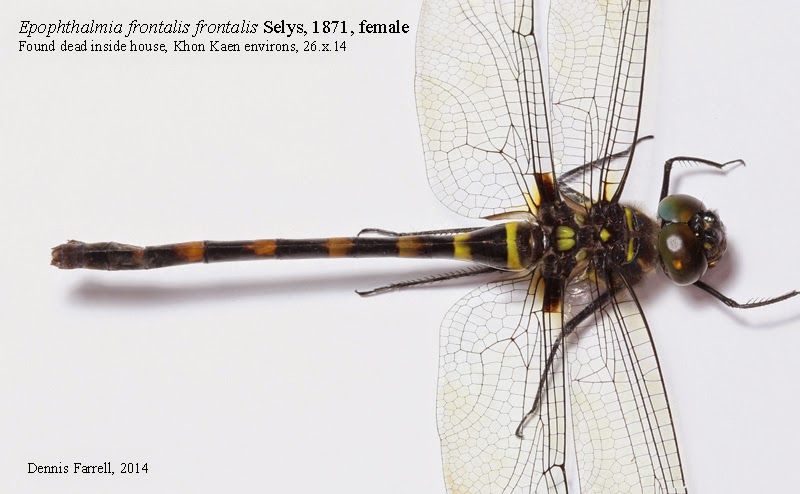
Who says you need lots and lots of patience to capture photos of dragonflies? Try cycling around the country roads and you may get a nice suprise. I did anyway. About 10 kms outside Khon Kaen, along a quiet country road, I cycled past a large, dead dragonfly, probably hit by a car. I stopped and picked it up. Unsure of the species, I carefully placed it into a small pouch I have under the seat where I normally keep my phone and cycled another 20 kms before returning home. Fortunately, it survived the journey and I was able to get good photos of it, before the ants moved in and left just a pair of wings! I searched the Internet and thought it was Epophthalmia frontalis frontalis, which was later confirmed as correct by Noppadon Makbun. Since then, I have spotted 2 more specimens (2 males and 1 female in total). Maybe they are more common that I thought in Khon Kaen, but rarely seen as they reside high up in the trees.

The male
Here is one of the males 'in situ'. Well, he is totally dead, but I just wanted his to look a little bit more natural and I think this is how they rest.


... and back to the better-for-science shots.


Wing venation 
This photo shows the distinctive hyaline wings with slight yellow colouration to the base of the hind wings.

Caudal appendages
Views of the terminal segments which also help with identification.

 Lateral view ...


Lateral view (from a slightly single angle) ...


Dorsal view ...


Basal view ...


The female
I have finaly managed to find a female ... and again, it is dead! This was dead in my brother's house, Khon Kaen. Thus, more unnatural shots ... though probably better from an ID point of view. Similar to the male, but slightly more robust. Also, note the eggs still attatched to the appendages.


Wing venation ...
 with broken tips - this was the better side! I think she was quite old.


The female appendages ...
amazing how the eggs are still attached!


Male vs. Female
I was lucky enough to also spot a female (this was my first female sighting), though she is really smashed up. It does, however, allow me to spot a few differences - the abdomen is more robust, the wings have a brown tinge (not clear like the male) and don't have any yellow colouration at the base. The eyes don't seem to be metallic either, though this could be simply because it has faded.


Tuesday, May 3, 2011

121: Ceriagrion fallax Ris, 1914

Number: 121 / Family: Coenagrionidae / Genus: Ceriagrion
 Species: Ceriagrion fallax / Black-tailed Marsh Dart
Habitat: Upland Forested Ponds
Province(s) sighted: Chiang Mai, Loei, Phitsanulok
Sightings (by me): Locally common
In flight (that I have seen): April-September 

Back in April 2010, I visited Doi Inthanon National Park in Chiang Mai for 10 days, 9 nights and camped alone... quite literally. I was pretty much the only person there. It was a wonderful place where I encountered numerous new species, and one I will return to for sure. One species I saw fairly regularly in the bushes away from water, was Ceriagrion fallax. It's similar to C. indochinense, which are common around many lowland areas, even Khon Kaen. However, much of the latter segments of the abdomen are black. Since then I have found it at a number uplands ponds. It can be hard to find, but should you find it, it is usually quite local, but move stealthily.

The Male
As you can see, the male is similar to C. indochinense, except for the prominent black dorsal markings from S7-10. Caudal appendages black also. He is a rather handsome fellow.


The Female
Female is quite dull in comparison, though I do like her colours. For me, the female seems less skittish than the male, but seldom seen.


The Copula
A few years back, I was fortunate enough to see a copula at Phu Hin Rong Kla National Park, Loei province. I have seen it couple of times but the always flew away (especially Phu Luang WS, Loei where there were many). This one, however, allowed me to fire off a few shots before retreating into the grasses.