Showing posts with label Platycnemididae. Show all posts

Sunday, April 5, 2026

252: Coeliccia doisuthepensis Asahina, 1984

   Number: 252 / Family: Platycnemididae / Genus: Coeliccia
Species: Coeliccia doisuthepensis Doi Suthep's Sylvan*
Province(s) sighted: Chiang Mai
Habitat: Forested Stream
In flight: July / Sightings (by me): Rare
Species easily confused with: All Coeliccia Species 

*As there is no common name, I have used 'Doi Suthep' from the Thai name and given the genus the name 'Sylvan', creating Doi Suthep's Sylvan.

One species I had often dreamt about and even looked for it at Phu Hin Rong Kla in hope... but never saw it was Coeliccia doisuthepensis. During a recent trip to Chiang Mai with Noppadon Makbun, we visited an area that is known to have the species amongst others. Sadly, like most other species, it didn't show as it was really dull and breezy. Suddenly, Noppadon pointed out a female in a real darkened area and a spent an age trying to get good shots, and they turned out OK. Then suddenly as I was walking up, I saw a male. It flew about 10 metres away from me and landed on a leaf that was constantly shaking from the breeze. I fired off a few shots but it very quickly became skittish and flew higher and higher up... and... gone. And that was it. I really was expecting it to be quite easy to shoot but nope. Another species I have to return to Chiang Mai to get improvement shots. 

The Male
The male is similar to other species in the genus but S9-10 are orange. There are also more markings present on the thorax. These were the best I could do on a windy day before it flew away.


The Female
Similar to most females in the genus, this one differs slightly due to the yellowish markings at the end of the abdomen.


I will return one day for better shots.


Sunday, March 29, 2026

219: Elattoneura aurantiaca (Selys, 1886)

 Number 219 / Family: Platycnemididae / Genus: Elattoneura
Species: Elattoneura aurantiacaRed-breasted Threadtail*
Habitat: Lowland Forested Peat Swamp
Province(s) sighted: Narathiwat
In flight: August / Sighting (by me): Locally common at one location
Species easily confused with: N/A

*Common name made up to match Threadtails

One species I expected to see at Sirindhorn Peat Swamp in Narathiwat was Elattoneura aurantiaca, which I have named the Red-breasted Threadtail as it has no common name but the genus is known as threadtails. It seems that everyone who visits there sees it... but for the first hour we didn't see any! It was very frustrating. However, as the day progressed, they started to appear though not in large numbers like all species found there. Ultimately, Noppadon and I were very happy to see both male, young and mature, a copula and a female, though difficult to photograph as they are small in size. 

The Male
The male is quite simply stunning with his red thorax and even brighter red eyes but a bugger to get good shots!


The 'Young' Male
Prior to the full red colour, the male is a nice greenish colour which I also think is very cool looking!


The 'Copula'
I was very happy indeed to manage to capture a 'wheel' or copula. Check out the female's bright blue eyes! 


The Female
Not the best shot in the world (it was late in the day and it was at a very awkward angle. But good enough for now. 


Monday, May 14, 2018

204: Prodasineura collaris (Selys, 1860)

Number: 204 / Family: Platycnemididae / Genus: Prodasineura
Species: Prodasineura collaris Collared Threadtail
Habitat: Seepage/overflow, swampy areas, connected to streams
Province(s) sighted: Narathiwat, Yala
In flight: April-August / Sightings (by me): Uncommon    
Species easily confused with: Prodasineura doisuthepensis

Though beautiful little damsels, Prodasineura species are difficult to get good photos of as they tend to hang around the edges of streams and very low down. It was no different when I saw a male Prodasineura collaris, commonly known as the Collared Threadtail. As light was fading fast, I managed to spot a male on my first day deep down perched over a tiny trickle. However, with the light almost gone so too did my chances of getting anything worthy of a good photo.

Two days later, I returned to the same spot and there was a female Prodasineura species on a stick just above a collection of leaves over seepage almost in the exact same place as the male. It was clearly a female P. collaris and she was fairly happy to let me snap away. Content with my shot of the female, I decided to go after the male once more. I pushed my way through bushes and dropped down about 5-6 feet to where there was a little bit more seepage/trickle and there he was. This time I managed to get a few fairly decent photos, especially as he was in such an awkward place. Since then I have returned to Narathiwat and Yala and found this species in a few locations, but it is definitely an uncommon species.

The male.
It is easy to ID this species and I am pretty sure it gets its name from the distinct blue band across its collar!


It typically sits low down just above the water...


The female.
The female is like most other females in the genus but it has a blueish tinge to it and fortunately for ID purposes, it was the only species in the area.


Wednesday, May 9, 2018

195: Prodasineura humeralis Selys, 1860

Number: 195 Family: Platycnemididae / Genus: Prodasineura
Species: Prodasineura humeralis* / Orange-striped Threadtail  
Habitat: Forested Sandy-bottomed Streams  
Province(s) sighted: Narathiwat, Songkhla, Yala
In flight: April-August / Sightings (by me): Locally common    
Species easily confused with: Prodasineura autumnalis, prodasineura verticalis


*In Thailand, this is currently known as Prodasineura sp. as it is possible that it is, in fact, P. autumnalis However, for the time being, I will keep it as P. humeralis, which is found commonly throughout Malaysia and would make sense that it is the same species.

One species that I expected to see at Hala-Bala did not disappoint, although it took a little bit of searching to find it. Instead of being at the wildlife sanctuary, it was fairly abundant at a couple of the more open and sandy-bottomed streams nearer the base of Bala. Prodasineura humeralis, commonly known as the Orange-striped Threadtail, is very similar in every aspect to P. autumnulis and P. verticalis and the genus needs revision. Like most species in the genus, it likes to hang low down near the stream's edges and is difficult to photograph. These were the best I could get in blazing sunshine, as my neck was slowly turning into the appearance of a gingerbread biscuit. Since then, I have returned to the deep south and this species was abundant at many forested streams throughout the region.

The male
The male is identifiable due to its dominant orange stripe on a black thorax, which gives it its common name. Can be found quite easily along shallow, slow-moving and sandy-bottomed streams.


Like other species in the genus, P. humeralis loves perching just above water level, making photography difficult.


The 'Young' Male
I was fortunate enough to spot a young male, which looks almost like every other species in the genus at this stage. Fortunately, it was the only species present making ID easy.

193: Coeliccia albicauda (Förster in Laidlaw & Förster, 1907)

Number: 193 / Family: Platycnemididae / Genus: Coeliccia
Species: Coeliccia albicauda / White-tailed Sylvan*  
Habitat: Forested stream  
Province(s) sighted:Narathiwat, Yala
In flight: April-August / Sightings (by me): Uncommon  
Species easily confused with: Coeliccia didymaCoeliccia nigrescensCoeliccia sp. (undescribed species) Coeliccia kimurai 

*Name changed to match Sylvan, which is used to describe the genus.

One species I should have come across whenever I visited the western part of Thailand is Coeliccia albicauda, known as the White-tailed Sylvan. However, until my last trip it had always eluded me for some reason. At Hala-Bala, however, I noticed a small C. loogali-sized damsel clinging on to a leaf on the ground along a dark and dingy trail. I managed to get a few shots away and then realised that it was in the bag! However, it proved to be an absolute nightmare to get anything that resembled a decent shot... and there was no way that I was settling for a record shot after waiting so long to see it. So, many, many, many attempts later I managed to get what I would deem pretty decent shots (to say that I was on my arse in a muddy puddle in poor lighting trying to take a photo of a dark needle over a muddy ditch). Still, they turned out OK in the end. I managed to spot a few more males during the trip but each and every one seemed to prefer darkened areas almost on the deck. I managed to get a glimpse of a female but it shot off before I could get any shots off.


The male


A typical pose while trying to get the right shot away (you can see the puddle it liked)...
*Photo of me courtesy of Sum Nara Nara (our awesome guide for the trip)

Sunday, July 5, 2015

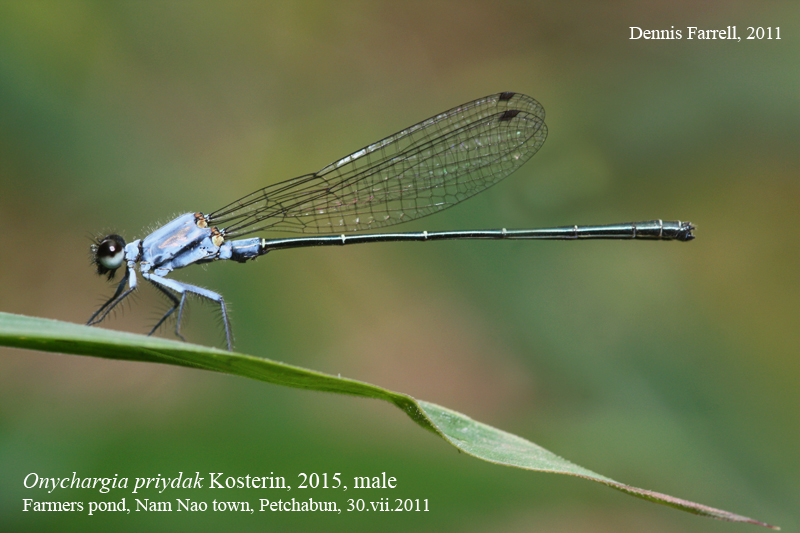
172: Onychargia priydak Kosterin, 2015

Number: 172 / Family: Platycnemididae / Genus: Onychargia 
Species: Onychargia priydak White-chested Dancer 
Habitat: Uncertain (I saw it at an upland farmer's pond during a storm) 
Province(s) sighted: Petchabun
Sightings (by me): Rare   
In flight (that I have seen): July   
Species easily confused with: N/A

So, the day after spotting a new species at school yesterday, I managed to spot another rare species, all from the comfort of my living room ... I think I may stop looking! A species I had photographed a good few years ago has finally been separated from Onychargia atrocyana. Onychargia priydak, is a species that looks like O. atrocyana, but differs superficially and is easily distinguished by having heavy white pruinesence on the thorax instead of the usual purplish-black. It has just been described by the amazing Oleg Kosterin, who described the species from Cambodia. Anyway, it is also present in Thailand and I believe in Hong Kong as well ... so if you come across a white wisp floating around take a closer look, you never know. 


Monday, August 6, 2012

150: Coeliccia sirindhornae Makbun, Phan, Ignatius & Keetapithchayakul, 2025

Number: 150 / Family: Platycnemididae / Genus:  Coeliccia
Species: Coellicia sirindhornae / Sirindhorn's Sylvan 
Habitat: Forested Streams
Province(s) sighted: Kanchanaburi
In flight: August / Sightings (by me): Rare
Species easily confused with: Coeliccia didyma

*As there is no common name, I have used 'Sirindhorn' from the Thai name and given the genus the name 'Sylvan', giving Sirindhorn's Sylvan.
**Since I wrote this post (2012), the species has been described (late 2025) and is now officially a species of Thailand! Many thanks to all involved for all your hard work. 

**A 2-hour drive from Kanchanaburi to Lamklong Ngu National Park, followed by a torrid drive through mud to only be told that the place was closed, was heart-wrenching. The pathway was blocked with fallen bamboo and there was no way through for the car. Unperturbed, I left the car at the entrance (with my girlfriend inside) and set off, climbing over bamboo and trees that had fallen over in the torrential rain. 

I reached the river ... awesome. Yet, unlike the last time when odonata were buzzing around everywhere, there were simply none. Nothing at all. I walked about 500 metres along an extremely slippery pathway, only to be greeted by a blocked section of the river, which caused mass flooding of the area and there was totally and utterly no way through. A waste of a journey. I turned back and made it to the entrance of the river. I looked along the sheltered trees to see if any specimens were taking refuge ... and there was a solitary Coeliccia didyma. I couldn't get a shot of him where he was (too far up and the leaf he was on was constantly bouncing from the rain drops), so I picked him up with my fingers and noticed something different about him ... the thoracic markings were totally different. Surely this wasn't C. didyma at all, was it? I scrambled to get my camera out of the bag again with one hand (the other held the specimen) and as I attempted to get the ring flash, the heavens opened once more. This time heavier than ever. There was no way I could use the ring flash - the water would have wrecked it for sure. Instead, I was limited to my camera without flash and in extremely low light. Crouched over my camera to keep it as dry as possible, I took a few photos, but just as I was about to take photos of the caudal appendages, I noticed that my camera bag was open and I reacted to close it and save may camera equipment and passport from certain death. By doing this I momentarily let go of the specimen and he flew about 5 metres high up into the branches - I could see him, but he was too far away. The rain continued to pour down heavily and I had to give up my search. 

The male is similar to that of C. didyma, but also resembles both C. nemoricola (endemic to Borneo) and C. octogesima (consigned to the very south of Thailand). However, looking at all 3 species [see asia-dragonfly.net], it is clearly none of them.

I have since had this confirmed by Noppadon Makbun that it is indeed a different species. However, it is yet to be described (and has been undescribed for a long time). The first record of this species was also recorded at the same place. So good news that it is a new species. Bad news, however, that it's not yet been described!

The male ...
Here is the standard shot in the hand ... he looks the same as C. didyma. However, there is a small black downward-turning protrusion at the base of the inferior caudal appendages.


Here is where the species differs much more. It looks like music notes ... 


Here I was trying to focus on the neck joint - the whiteish-grey joint between the head and the neck (sorry for not knowing the correct technical words) If you look closely, you can clearly see 2 small blue arrow shaped marks.


Unfortunately, as I was about to photograph the caudal appendages, all hell broke loose and he was able to fly up into the trees. 

Hopefully, one day, it will be described and I can give him a name!
Many thanks to Noppadon for the info!

Saturday, April 2, 2011

108: Prodasineura laidlawii (Förster in Laidlaw, 1907)

No: 108 / Family: Platycnemididae / Genus: Prodasineura
Name: Prodasineura laidlawii Laidlaw's Threadtail
Habitat:  Slow, uplands rivers and streams
Province(s): Kanchanaburi, Phuket, Narathiwat, Yala, Songkhla
In flight: March-August / Sightings (by me): Locally common
Easily confused with: N/A

My recent trip to Kanchanaburi proved to be fairly successful, even though it is early in the 'flight' season. I will post all my findings as they are identified by Noppadon Makbun. Some, though, are easy to identify, even by me!

The first species I found and one I expected to see was Prodasineura laidlawi, my 6th species from the Prodasineura genus. I now just need to find, P. humeralis and P. collaris to complete the set. Hopefully I will find these species when I travel south in October. Since then, I have travelled extensively in the deep south and managed to find both the these species, alongside P. laidlawi on several occasions. 

The male
The male is easy to identify and perches on twigs and leaves at the edge of the river. They are easy to spot with their blue stripes on the thorax. Segments 9-10 are blue dorsally and the caudal appendages are also blue. 


S8 also has a blue mark which changes as it ages. See photos below.


See how the marking on S8 has become more prominent as it ages.


A Copula
I wasn't able to spot an individual female in the short time I visited Kanchanaburi, but I did manage to see a copula. You can see that the female is similar to the male, but much duller.


You can see this species in Kanchanaburi all year, especially at Erawan waterfall (if you can handle photographing nature amongst thousands of tourists in speedos). 

Friday, March 4, 2011

81. Onychargia atrocyana (Selys, 1865)

No: 81 / Family: Platycnemididae / Genus: Onychargia
Name: Onychargia atrocyana Marsh Dancer 
Habitat: Exposed Ponds and Lakes (Uplands & Lowlands)
Province(s): Widespread
In flight: Year-round / Sightings (by me): Locally common
Easily confused with: N/A

When I was in Bangkok about 3 1/2 years ago, I spotted a small black damselfly and had no idea what it was. A year later I possibly spotted the same species at a tiny pond overgrown by weeds just outside Khon Kaen. I managed to take a photo of the male and it was identified by Noppadon Makbun as Onychargia atrocyana. I returned to the same pond and managed to get photos of the species at all stages. 

The Male
The mature male is completely black (sometimes has purple hues). Most, however, have white rings on the joints of each section of the abdomen. The anal appendages are unique too.


The 'Young' Male
The young male hasn't yet become completely black and looks a lot more like the female with distinct yellow stripes on the abdomen.


Here it is a little more black on the thorax.


The 'Teneral' Male


This specimen has one wings that still hasn't full opened out (or it is deformed). I saw this early one morning at a lake just outside Phu Wiang National Park, Khon Kaen. 


The Female
The female is very close to the young male with prominent yellow and black stripes on the thorax.


The 'Teneral' Female
This female has just emerged and again, it was very early in the morning. I saw this specimen at Nam Nao National Park, Petchabun.


And for a very short life... another teneral female, it had probably lived for a few hours, if it was lucky.


The Tandem
The male is displaying its shiny purple thorax.