Showing posts with label Agriocnemis. Show all posts

Friday, March 11, 2011

105. Agriocnemis femina femina (Brauer, 1868)

No: 105 / Family: Coenagrionidae / Genus: Agriocnemis
Name: Agriocnemis f. femina Variable Wisp แมลงปอเข็มเล็กขนขาว
Habitat:  Small to medium sized ponds and lakes, surrounded by grasses
Province(s): Widespread
In flight: Year-round / Sightings (by me): Very common
Easily confused with: Agriocnemis minima, Agriocnemis pygmaea

Another microscopic species that belongs to the Agriocnemis genus, is Agriocnemis femina femina. I have overlooked this species for long periods of time, basically because I used to think that a pruinosed Agriocnemis pygmaea was in fact this species (yes, I had a lot to learn back then!) I then learned that this species wasn't actually even present in Khon Kaen and the surrounding areas. Well, in over a year of searching I have only come across A. pygmaea (No. 18 on my blog) and A. minima (No. 17 on my blog). I eventually saw a male in Chiang Mai, but didn't really take much notice of it. It was only when I visited Khao Soi Dao NP that I noticed a small ditch early in the morning just outside the entrance. I had a quick look and noticed Agriocnemis was present. I managed to get a good photo of a pruinosed male and YES! it was A. femina (I have to take a photo to tell the species apart as they are so small). That was the only Agriocnemis species present at that ditch. Since then, I have seen this species at many locations.

The 'mature' male
At certain times of the year (seems to be late in the year), there are hundreds of these little fellows seemingly floating around like little bits of fluff. I think they look great close up. Can be identified by its anal appendages.


Agriocnemis femina, close up - cleaning his appendages (explained to me by Noppadon Makbun)


Agriocnemis femina, close up - now showing a strange appendage near his genitalia

A semi-mature male
Still has slightly red end segments, but is only half pruinosed 


The young male
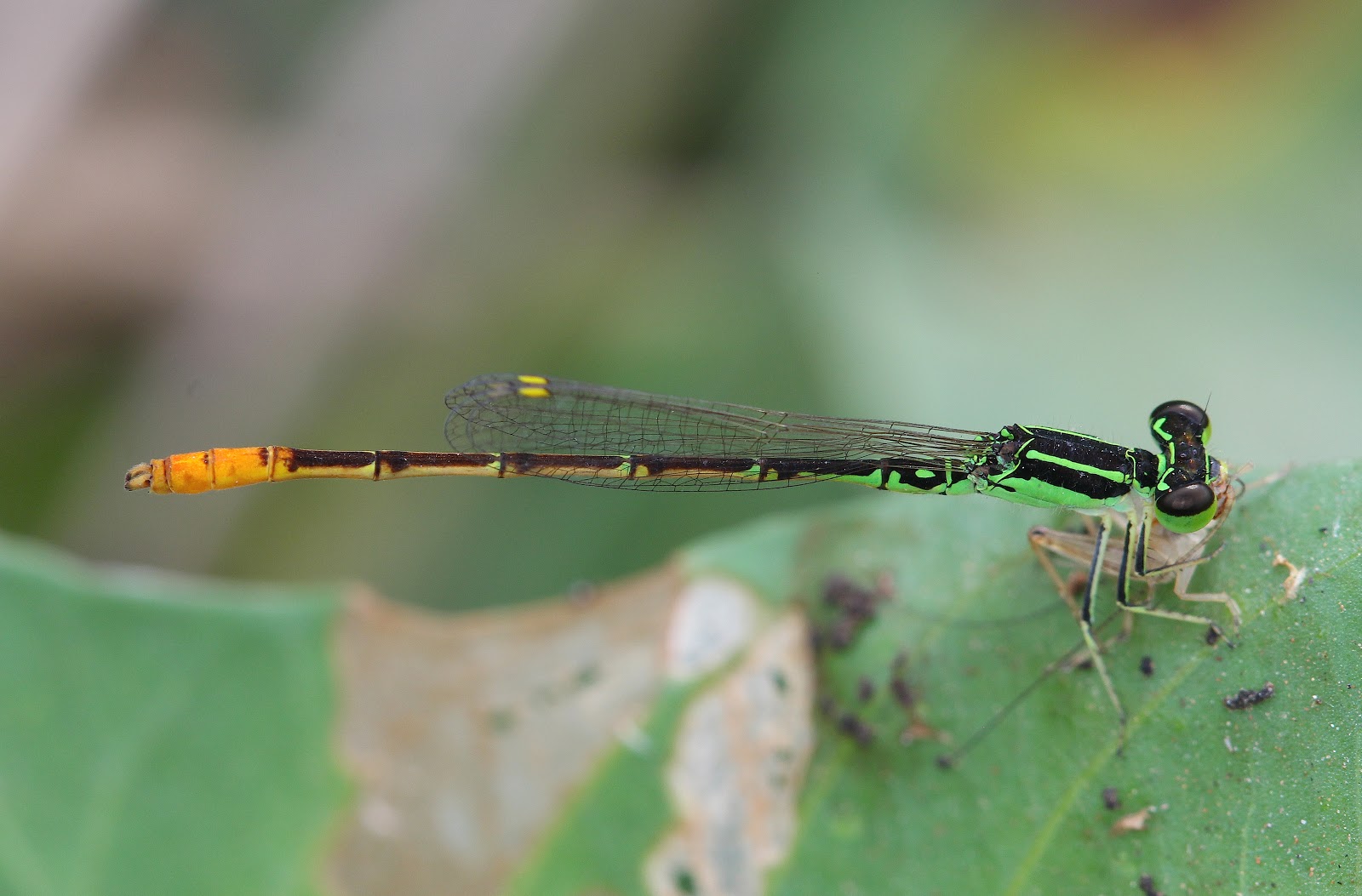
The young male is the most common of all and is almost identical to Agriocnemis pygmaea, except for the caudal appendages. It is also possible to identify as A. femina as S7 has more of a physical change from black to orange, whereas S7 on A. pygmaea is more of a gradual change from black to orange.


Caudal appendages
Agriocnemis femina, male (caudal appendages) - the easy way to differentiate this species. Looks a bit like a character from the Muppets, I think. 


The 'old' female
This very old female I can only correctly identify, as it was the only Agriocnemis species present at a small ditch in Chantaburi. It's the easy way to tell! If both species were present, I'm not sure I could tell the difference at this stage.


The sub-adult female
The young female can be identified by having prominent black marks on the pronotum (neck). 


The 'green' female


The copula
Here's a young male with a very young female.


Not the best angle in the world, as they sat really low down in a ditch and I couldn't get anywhere near low enough. This is an old male with a very young female... this would be deemed illegal in the human world!

Saturday, February 26, 2011

18. Agriocnemis pygmaea (Rambur, 1842)

No: 18 / Family: Coenagrionidae / Genus: Agriocnemis
Name: Agriocnemis pygmaea Pygmy Wisp แมลงปอเข็มแคระธรรมดา
Habitat: Exposed ponds/lakes/ditches (in the grasses) lowlands/uplands
Province(s): Widespread
In flight: Year-round / Sightings (by me): Common
Easily confused with: Agriocnemis femina; Agriocnemis minima

The third species of Agriocnemis I have seen is Agriocnemis pygmaea, which is extremely common throughout Thailand. Any waterway is sure to have one or two of these little fellows hanging around. They are not easy to spot and because of their size are difficult to photograph, but they are worth the effort. 

The male
The male is pretty easy to identify. It is similar to A. femina femina, but the anal appendages are different. A. pygmaea has two small anal appendages. The male's thorax becomes pruinosed as it matures.


Here is a fully mature male. You can clearly see how the thorax takes on a whiteish colour. Also, the orange end segments fade and become black.


The female
The female takes on many colours throughout its life. Below is the 'green' adult female.


Here is a slightly younger female. It still has a touch of brown.


This is a sub-adult female, which is more of a reddish-brown colour.


Here is a newly emerged female. It will only be a few hours old. You can still make out the markings.


For the first recently, I saw a female that also had become pruinose. Shows that I am still learning!


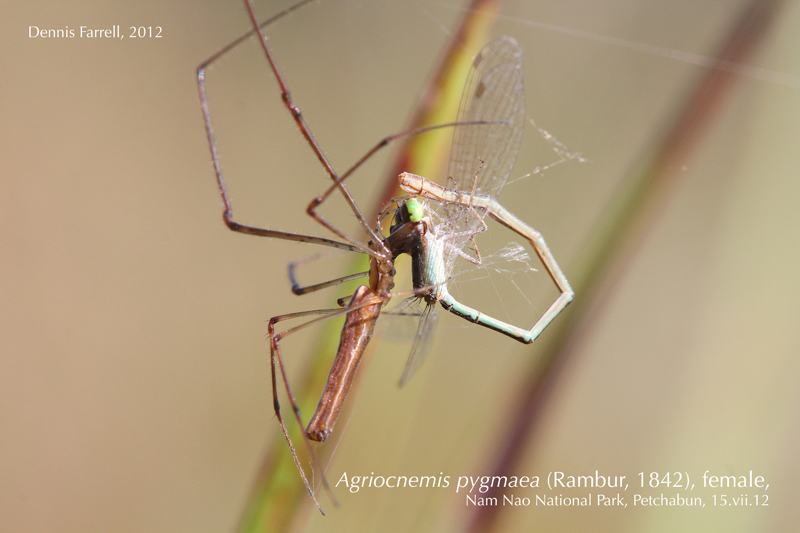
Early morning breakfast ... unfortunately


The copula
This is a fairly common sight, here in the "wheel" position. However, it is really difficult to get good photos as they are so small and live close to the ground in the grasses.

17. Agriocnemis minima (Selys, 1877)

No: 17 / Family: Coenagrionidae / Genus: Agriocnemis
Name: Agriocnemis minima Marsh Wisp
Habitat: Exposed Ponds But With Grassy/Weedy Verges
Province(s): Widespread
In flight: March to December / Sightings (by me): Locally common
Easily confused with: Agriocnemis pygmaeaAgriocnemis femina

Agriocnemis minima is one of seven species of Agriocnemis to be found in Thailand. It is also one of the most common, second only to A. pygmaea. There are supposed to be three common Agriocnemis species found in paddy fields throughout Thailand but I have only found two to be common in Khon Kaen and the surrounding areas. A. femina femina doesn't seen to be present. Agriocnemis is a tiny genus and very often overlooked, as they are tiny. The other problem is correctly identifying the different species. I think differentiating the males is easy, but the females are far more difficult.

The Male
The male is easy to identify, especially the adult. It has a green/black striped thorax and a vivid orange abdomen. It also has a distinctive "mask" mark on the 2nd segment of the abdomen. The other big difference on this tiny species, are the anal appendages, which are very prominent (see photo).


The caudal appendages
With such long appendages, this species is the easiest to identify in the genus.


The Female
The female is far more difficult to identify. Like other Agriocnemis species, the female changes colour as it matures. It starts off a bright orange/red colour and darkens as it matures, ending up grey (as the first female shown). 


The 'Old' Female
The females start to develop a blue-grey pruinescence like this one as they age.


The 'Youngish' Female
This female is at the "mid-stage" of its colour change.


The 'Young' Female
This newly-emerged female is at the very early stage of its colour change.


This species can be found in any field near a waterway. It particularly likes to be in the open, amongst grassy areas that grow near swampy areas, ditches and ponds. I think it can be found all year round, though it seems to be more abundant in Khon Kaen from the rainy season (July) until around March. But don't forget... you really have to look closely for it as it is so small. 

Tuesday, December 14, 2010

2. Agriocnemis nana (Laidlaw, 1914)

No: 2 / Family: Coenagrionidae / Genus: Agriocnemis
Name: Agriocnemis nana Dwarf Wisp
Habitat: Uplands Ponds
Province(s): Chaiyaphum, Chantaburi, Nakhon Nayok, Nakhon Ratchasima, Petchabun
Sightings (by me): Locally common
In flight: Year-round 
Easily confused with: N/A

Another tiny species, possibly the smallest in Thailand. Agriocnemis nana, a stunning little damselfly that loves hiding in the grasses near uplands ponds, marshland and ditches. It is quite common at uplands ponds and lakes where there is long grass of good foliage for them to hide in.

The Male
Although tiny, its stunning colours make it quite easy to spot. It has lime green stripes along a black thorax. The ocular stripe is also bright green. Stigma and face are blue. S1-2 are green on the abdomen. S2 also has a unique 'mask' mark. 6-8 blue, with black dorsal markings and black basal rings. S9-10 are black with blue basal ring (this varies). Caudal appendages are blue.


Here's a mature male I captured last year ... see how the dorsal markings near the end segments are filled in here, whereas the above male has a kind of African mask look. 


An (almost) adult male
This is a younger male specimen. It is the only one I have seen like this. It has all the markings of the adult, but doesn't quite yet have the full colouring. Still a great looking damselfly though.


The 'Teneral' Male
This is a very young male specimen. It is yet to gain its colours, but still has the same markings.


The Female
The female is similar to the male, but slightly duller and has a stouter abdomen. The markings are slightly different too.


The 'Teneral' Female
I have seen many, many specimens of this species and this is the first I have seen like this. Very cool I think. Looks like A. minima a little, but it isn't present where I saw it, making ID easier.


The (very old) female
Similar to the above female, but seems to have lost its colour. The end segments are also pruinosed.


A (very young) female
Again, this female has the same markings as the adult, but is much duller in colour. This female was hiding further away from the water than mature females.


I'm not sure if this species is supposed to be common, but I only saw it for the first time this year. I saw it at Nam Nao National Park in October (and now February). The following week, I saw it gain at Mukdahan National Park. I then visited Khao Khrating, near Chantaburi, in December and saw hundreds of them by the roadside!