Showing posts with label Ictinogomphus. Show all posts

Sunday, April 5, 2026

253: Ictinogomphus rapax (Rambur, 1842)

    Number: 253 / Family: Gomphidae / Genus: Ictinogomphus
Species: Ictinogomphus rapax Indian Common Clubtail
Province(s) sighted: Petchabun, Chiang Mai
Habitat: Forested Ponds, Marsh
In flight: March - July / Sightings (by me): Rare
Species easily confused with: Ictinogomphus decoratus melaenops

One species I actually saw back in 2010 and then again on occasion (alegedly) over the years but didn't actually know it, is Ictinogomphus rapax. Commonly known as the Indian Common Clubtail, it looks identical to I. decoratus and it took a while for people to work out how to separate the two species. It appears that, other than additional markings on the thorax (though that isn'y always the case), the key to ID is a solid ring on S8 near the end of the abdomen.

The Male
This male sat on my hard drive for many years, leaving me to think it was Ictinogomphus decoratus melaenops... but you can clearly see the solid yellow ring towards the end of the abdomen.


Here is another specimen I saw back in 2010! Yep, it sat there for 15 years as the wrong species!


So, if you have lots of photos of the common species, take a look as you never know! I a sure I have more too.

Monday, March 30, 2026

234: Ictinogomphus acutus Laidlaw, 1914

           Number: 234 / Family: Gomphidae / Genus: Ictinogomphus
Species: Ictinogomphus acutus Rusty Clubtail*
Province(s) sighted: Narathiwat
Habitat: Peat Swamp Forest
In flight: August / Sightings (by me): Rare
Species easily confused with: N/A

*As there is currently no common name, I have based the name on the genus being known as 'Clubtails' and the appendages of the species having a unique 'rusty' colour. 

Like many species at Sirindhorn Peat Swamp Forest, Ictinogomphus acutus eluded us 'til the last. My brother saw this species a year or so earlier and managed to get a decent shot of it, which we quickly named it the Rusty Clubtail, due to its abdomen end segments. When we arrived, it was nowhere to be seen... except it was! Paul's missus, Suu, saw it perching in the trees and took some nice photos which I will add when I get them processed. Paul even sent images of where it was! But the dragonfly guys (me and Noppadon Makbun) missed it again. 2-0 to the birders! As we searched for it, the birders returned and explained where it was... but we couldn't see it. The other guys wandered off looking for birds. Suddenly, there it was... massive... it WAS still in that tree but it shot off and we watched it disappear over the other side of the lake. It returned shortly afterwards, circled the lake and then, instead of landing in the same tree, it decided it had had enough and zoomed high and far into the distance. It was a beautiful, if not fleeting, glimpse of it, but enough to count it for my records. Until I return, I am using Paul's shot of it from his previous trip.

The Male
The male is very easy to recognise and is found in Mainland Malaysia just over the border so it isn't a surprise to find it here. Check out the 'rusty' end of its abdomen... definitely a beast of a dragonfly and hope to get my own photos next trip!


Photo courtesy of my brother, Paul, as a placement photo until I can get my own (and not just see it whizzing around the lake twice haha). Many thanks, r kid!


Sunday, March 6, 2011

100. Ictinogomphus decoratus melaenops (Selys, 1854)

No: 100 / Family: Gomphidae / Genus: Ictinogomphus
Name: Ictinogomphus decoratus melaenops Common Flangetail 
Habitat:  Exposed Ponds, Lakes and Slow Sreams (Uplands & Lowlands)
Province(s): Widespread
In flight: Year-round / Sightings (by me): Extremely common

A large Gomphidae I see almost every trip patrolling large lakes and ponds, is Ictinogomphus decoratus melaenops. It must be the most common Gomphidae of all. It is easy to identify and fairly easy to get near to as it often returns to the same stick.

The Male
The male is black with strong yellow markings along the thorax and abdomen. The base of S-1 and S2 (partially) are white. The frons is yellow and the eyes are blue/green. The caudal appendages are also very long and the end segments are "club" like.


Be careful with this species... I have bought a small net to capture some species for identification, before release. I am now going to try and take photos of all species in nature and in hand. All dragonflies bite, but it is so weak, you can't even feel it. This bugger, on the other hand, had a really good bite. And, though it didn't draw blood, I could really feel it! Well worth the effort though!


The 'Teneral' Male 
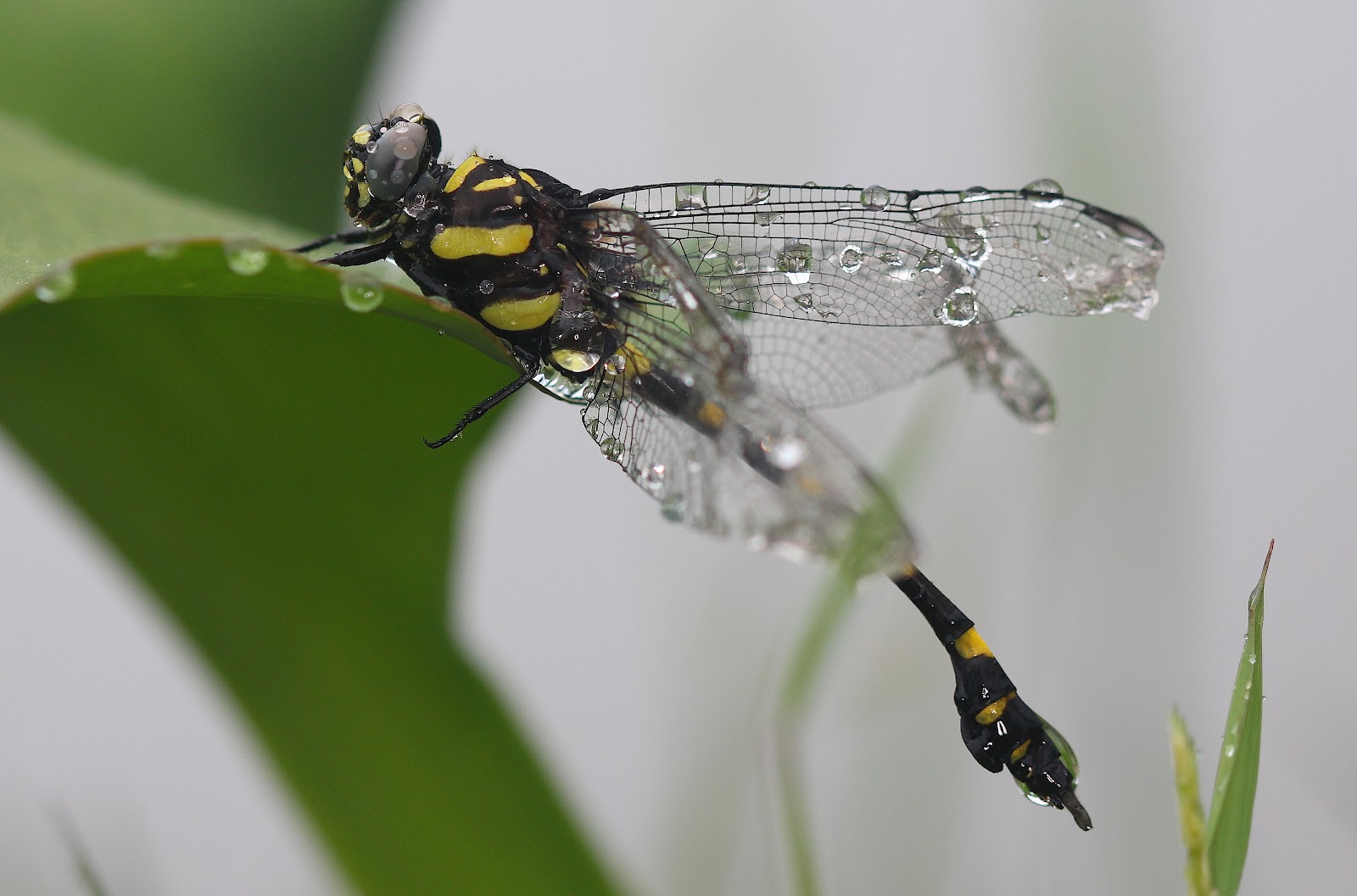
 ... not off to the best start. This male had to endure torrential rain just after it had emerged at the Helicopter Pad, Nam Nao.


Here's the exuviae from which he emerged ...


The Female
This is the only the second female I have managed to photograph in 6 years. Unlike the male, they tend to hide away more up in the treetops. The markings are slightly different to that of the male.


This specimen has a deformed abdomen but I doubt it will cause it too many problems.