Sunday, February 27, 2011

20. Calicnemia miles (Laidlaw, 1917)

No: 20 / Family: Platycnemididae / Genus: Calicnemia
Name: Calicnemia miles Red-striped Mountain Damsel* 
Habitat: Sluggish (Almost Dried Out) Uplands Forested Streams
Province(s): Chiang Mai
In flight: April & June / Sightings (by me): Uncommon
Easily confused with: Calicnemia chaseniCalicnemia erythromelas

*No common name so based it on an existing name of 'Mountain Damels' for Calicnemia and 'Red-striped for obvious reasons.

When I visited Chiang Mai for two months in March-May 2010, one of the species Noppadon Makbun told me to look out for was Calicnemia miles. I look for it, as well as many other species, but I thought it was going to elude me. Then, one day, in late April I saw two males and a female high up Doi Inthanon. They like really dark areas and maybe I had just missed them before. But once I had noticed the male, it was really obvious. Since seeing this species, I have returned to Chiang Mai and saw a healthy number at Doi Suthep.

The Male
The male is stunning, with red, black and white stripes on the thorax and a bright red abdomen. The end segments are completely black.


The Female
The female is similar to the male, but is much duller in comparison and the abdomen is more robust.


This female was busy cleaning herself off following ovipositing.


A copula
Amazingly, I went back to see if I could find them again two days later (as I wasn't happy with the original photos) and there they were... in a copula! I was so happy to see that.


Ovipositing
I watched the copula for a while and was really happy when the female began ovipositing. Unfortunately, they really liked to be a darkened, shaded area so I had to use flash. She likes to lay her eggs on rotting roots, in the minimal amount to water. The tiny stream was almost dry.


I'm not sure of the distribution of this species. All I know is that it is in flight while I was in Chiang Mai, in April. Also, if you look for this species, it loves shaded areas, so look carefully!

19: Pseudagrion siamense (Fraser, 1922)

No: 19 / Family: Coenagrionidae / Genus: Pseudagrion
Name: Pseudagrion siamense Blue Sprite
Habitat: Exposed ponds/lakes, and slow-moving streams, lowlands & uplands
Province(s): Widespread
In flight: Year-round / Sightings (by me): Locally common

A common, but still stunning species is Pseudagrion siamense (recently split from P. microcephalum). I have seen this species on numerous occasions, in many lowland areas. It is easily confused with another species, P. australasiae. Though easy to spot, it is difficult to get good photographs as it seem always ready to fly away at the slightest movement.

The male
The bright blue and markings makes it easy to spot, but it is often confused with P. australasiae. However, it is brighter blue, smaller in size and has longer superior appendages (the black appendages at the end of the abdomen). 


The sub-adult male
The young males are seldom seen by the waterside, but if you look in the trees and bushes that surround water where the males are present, it is possible to find them, often close to the females.  The colours are very similar to that of the female. He will eventually turn bright azure blue.


The female
Like sub-adult males, the female tends to hide away and only appears in the open when it's ready to copulate.


A copula
Often the best way to tell the females apart, is to wait for them to copulate. However, you may be waiting for some time! This copula (wheel) I saw in Narathiwat and the tandem in Chantaburi.


I have spotted this species many many times in Khon Kaen, as well as many other places. They tend to like ditches, ponds and lakes, but I have seen them from time to time along very slow, almost still streams.  I have seen them almost all year round, but they seem most common between October-March.

Saturday, February 26, 2011

18. Agriocnemis pygmaea (Rambur, 1842)

No: 18 / Family: Coenagrionidae / Genus: Agriocnemis
Name: Agriocnemis pygmaea Pygmy Wisp แมลงปอเข็มแคระธรรมดา
Habitat: Exposed ponds/lakes/ditches (in the grasses) lowlands/uplands
Province(s): Widespread
In flight: Year-round / Sightings (by me): Common
Easily confused with: Agriocnemis femina; Agriocnemis minima

The third species of Agriocnemis I have seen is Agriocnemis pygmaea, which is extremely common throughout Thailand. Any waterway is sure to have one or two of these little fellows hanging around. They are not easy to spot and because of their size are difficult to photograph, but they are worth the effort. 

The male
The male is pretty easy to identify. It is similar to A. femina femina, but the anal appendages are different. A. pygmaea has two small anal appendages. The male's thorax becomes pruinosed as it matures.


Here is a fully mature male. You can clearly see how the thorax takes on a whiteish colour. Also, the orange end segments fade and become black.


The female
The female takes on many colours throughout its life. Below is the 'green' adult female.


Here is a slightly younger female. It still has a touch of brown.


This is a sub-adult female, which is more of a reddish-brown colour.


Here is a newly emerged female. It will only be a few hours old. You can still make out the markings.


For the first recently, I saw a female that also had become pruinose. Shows that I am still learning!


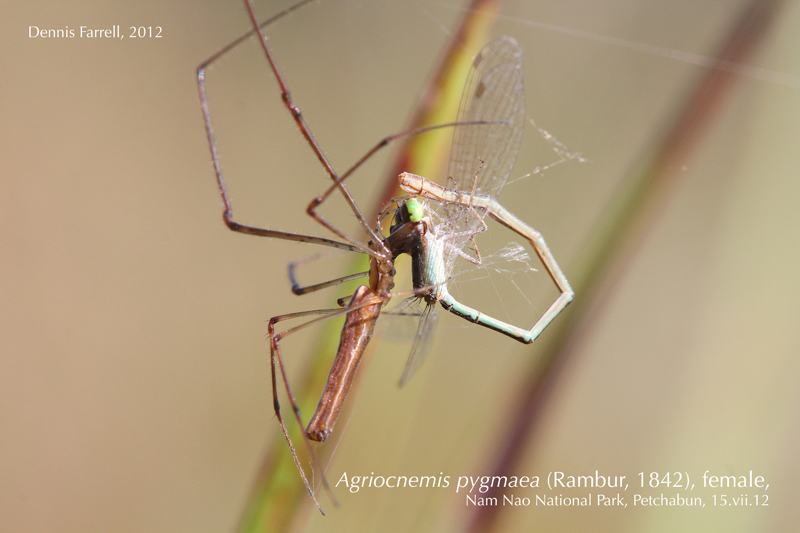
Early morning breakfast ... unfortunately


The copula
This is a fairly common sight, here in the "wheel" position. However, it is really difficult to get good photos as they are so small and live close to the ground in the grasses.

17. Agriocnemis minima (Selys, 1877)

No: 17 / Family: Coenagrionidae / Genus: Agriocnemis
Name: Agriocnemis minima Marsh Wisp
Habitat: Exposed Ponds But With Grassy/Weedy Verges
Province(s): Widespread
In flight: March to December / Sightings (by me): Locally common
Easily confused with: Agriocnemis pygmaeaAgriocnemis femina

Agriocnemis minima is one of seven species of Agriocnemis to be found in Thailand. It is also one of the most common, second only to A. pygmaea. There are supposed to be three common Agriocnemis species found in paddy fields throughout Thailand but I have only found two to be common in Khon Kaen and the surrounding areas. A. femina femina doesn't seen to be present. Agriocnemis is a tiny genus and very often overlooked, as they are tiny. The other problem is correctly identifying the different species. I think differentiating the males is easy, but the females are far more difficult.

The Male
The male is easy to identify, especially the adult. It has a green/black striped thorax and a vivid orange abdomen. It also has a distinctive "mask" mark on the 2nd segment of the abdomen. The other big difference on this tiny species, are the anal appendages, which are very prominent (see photo).


The caudal appendages
With such long appendages, this species is the easiest to identify in the genus.


The Female
The female is far more difficult to identify. Like other Agriocnemis species, the female changes colour as it matures. It starts off a bright orange/red colour and darkens as it matures, ending up grey (as the first female shown). 


The 'Old' Female
The females start to develop a blue-grey pruinescence like this one as they age.


The 'Youngish' Female
This female is at the "mid-stage" of its colour change.


The 'Young' Female
This newly-emerged female is at the very early stage of its colour change.


This species can be found in any field near a waterway. It particularly likes to be in the open, amongst grassy areas that grow near swampy areas, ditches and ponds. I think it can be found all year round, though it seems to be more abundant in Khon Kaen from the rainy season (July) until around March. But don't forget... you really have to look closely for it as it is so small. 

16. Ceriagrion auranticum (Fraser, 1922)

No: 16 / Family: Coenagrionidae / Genus: Ceriagrion
Name: Ceriagrion auranticum Green-orange Marsh Dart* แมลงปอเข็มสีพื้นเขียวส้ม
Habitat: Densely covered foliage near ponds/lakes, lowlands (and occasionally uplands)
Province(s): Widespread
In flight: July to January / Sightings (by me): Locally common

The first Ceriagrion species I saw in Khon Kaen was Ceriagrion auranticum. It used to be common, but I seem to see less and less of them nowadays. It is one of twelve species of Ceriagrion known in Thailand and I have now seen seven. I would say that this is the most common. 

The male 
The male has a striking reddish/orange abdomen and greenish thorax. They are extremely skittish and fairly difficult to get close to. However, if you spot one, try looking in the longer grasses nearby. Sometimes there are many males and females hiding there. 


The sub-adult males
Young and newly emerged males are not often seen - and are difficult to ID. However, only C. auranticum was the only present species of the genus when I saw these specimens.

A sub-adult male. The abdomen is right, yet the thorax isn't in full colour.


Here's a newly emerged male similar to the specimen above, yet the abdomen is almost translucent and the wings are very 'fresh'.


The female
The female is very similar to the male and seems to have 2 distinct stages. One has more of a grey/brown abdomen and the other is far closer to that of the male, being reddish in colour (is this the final stage of maturity?). Both stages I have seen as part of a copula, though never got a decent photo. Here is the most common form of the female.


The 'red' female 


This specimen has distinct black dorsal markings at on the end segments, quite often seen with the females of this species.


Ceriagrion auranticum can be spotted all around Khon Kaen and I have also seen it at numerous places around Thailand. It seems to be most abundant in the winter months, most commonly seen from October-January and likes to hide in thick overgrowth on the edge of ponds and lakes, though I have spotted the species near slow moving rivers too.