Monday, June 6, 2011

122: Epophthalmia v. vittata Burmeister, 1829

Number: 122 / Family: Macromiidae / Genus: Epophthalmia
Species: Epophthalmia v. vittata / Spotted Torrent Hawk
Habitat: Lowland ponds/Slow-moving Streams
Province(s) sighted: Khon Kaen
In flight: June-October  / Sightings (by me): Fairly Common
Species easily confused with: All Epophthalmia Species

Who says you need lots and lots of patience to capture photos of dragonflies? Try cycling around the country roads and you may get a nice suprise. I did anyway. About 10 kms outside Khon Kaen, along a quiet country road, I cycled past a large, dead dragonfly, probably hit by a car. I stopped and picked it up. Unsure of the species, I carefully placed it into a small pouch I have under the seat where I normally keep my phone and cycled another 20 kms before returning home. Fortunately, it survived the journey and I was able to get good photos of it, before the ants moved in and left just a pair of wings! I searched the Internet and thought it was Epophthalmia frontalis frontalis, which was later confirmed as correct by Noppadon Makbun. Since then, I have spotted 2 more specimens (2 males and 1 female in total). Maybe they are more common that I thought in Khon Kaen, but rarely seen as they reside high up in the trees.

The male
Here is one of the males 'in situ'. Well, he is totally dead, but I just wanted his to look a little bit more natural and I think this is how they rest.


... and back to the better-for-science shots.


Wing venation 
This photo shows the distinctive hyaline wings with slight yellow colouration to the base of the hind wings.

Caudal appendages
Views of the terminal segments which also help with identification.

 Lateral view ...


Lateral view (from a slightly single angle) ...


Dorsal view ...


Basal view ...


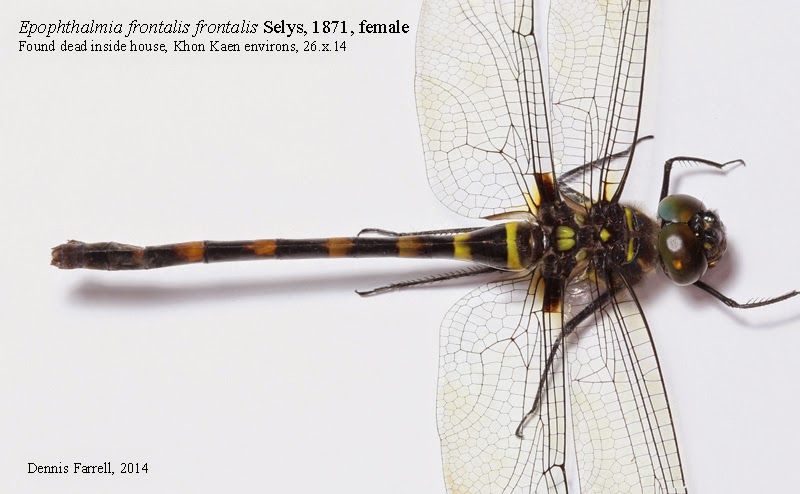
The female
I have finaly managed to find a female ... and again, it is dead! This was dead in my brother's house, Khon Kaen. Thus, more unnatural shots ... though probably better from an ID point of view. Similar to the male, but slightly more robust. Also, note the eggs still attatched to the appendages.


Wing venation ...
 with broken tips - this was the better side! I think she was quite old.


The female appendages ...
amazing how the eggs are still attached!


Male vs. Female
I was lucky enough to also spot a female (this was my first female sighting), though she is really smashed up. It does, however, allow me to spot a few differences - the abdomen is more robust, the wings have a brown tinge (not clear like the male) and don't have any yellow colouration at the base. The eyes don't seem to be metallic either, though this could be simply because it has faded.


Tuesday, May 3, 2011

121: Ceriagrion fallax Ris, 1914

Number: 121 / Family: Coenagrionidae / Genus: Ceriagrion
 Species: Ceriagrion fallax / Black-tailed Marsh Dart
Habitat: Upland Forested Ponds
Province(s) sighted: Chiang Mai, Loei, Phitsanulok
Sightings (by me): Locally common
In flight (that I have seen): April-September 

Back in April 2010, I visited Doi Inthanon National Park in Chiang Mai for 10 days, 9 nights and camped alone... quite literally. I was pretty much the only person there. It was a wonderful place where I encountered numerous new species, and one I will return to for sure. One species I saw fairly regularly in the bushes away from water, was Ceriagrion fallax. It's similar to C. indochinense, which are common around many lowland areas, even Khon Kaen. However, much of the latter segments of the abdomen are black. Since then I have found it at a number uplands ponds. It can be hard to find, but should you find it, it is usually quite local, but move stealthily.

The Male
As you can see, the male is similar to C. indochinense, except for the prominent black dorsal markings from S7-10. Caudal appendages black also. He is a rather handsome fellow.


The Female
Female is quite dull in comparison, though I do like her colours. For me, the female seems less skittish than the male, but seldom seen.


The Copula
A few years back, I was fortunate enough to see a copula at Phu Hin Rong Kla National Park, Loei province. I have seen it couple of times but the always flew away (especially Phu Luang WS, Loei where there were many). This one, however, allowed me to fire off a few shots before retreating into the grasses.


Wednesday, April 27, 2011

120: Dysphaea gloriosa (Fraser, 1938)

Number: 120 / Family: Euphaeidae / Genus: Dysphaea 
Species: Dysphaea gloriosa
Common name(s): Glorious Velvetwing
Thai name(s): N/A
Habitat: Forested Rocky Streams 
Location(s): Chaiyaphum, Nakhon Ratchasima, Petchabun, Loei, Trat 
In flight: April-July / Sightings (by me): Locally common
Species easily confused with: Euphaea o. ochracea

*As there is no common name, I took the species name 'gloriosa' meaning 'Glorious' and 'Velvetwing' being the most consistent name given to the genus, Dysphaea.

A species that confused me so much was Dysphaea gloriosa. It looks so much like Euphaea ochracea, it is unbelievable. But when I saw it fly, it looks so different and thought that it must be a new species. It is bigger, the wings are solid ochre and it flies completely differently (the wings tend to move in a circular motion). The caudal appendages are much longer too. I sent photos to Noppadon Makbun and he confirmed that it was Dysphaea gloriosa, which I have named the Glorious Velvetwing, so a new species for me! Since then I have seen this species at numerous locations and can be the dominant species.

Anyway, it taught me a lesson. If you see a damselfly that looks slightly different... take lots of photos as it might be a new species!

The Male
It really is a stunning river dweller that has very long wings and are an obvious ochre colour. It is easily confused with Euphaea ochracea but the wings and the way it fly make it easier to pick out in the field.


Interestingly, this male has a distinct black tip and the whole population (15+ specimens) at a small stream on Koh Kood, Trat, were all the same. 


Here he is in a more natural position. They tend to 'hug' whatever they land on (large logs and rocks)...


Male in the hand. This shows how much larger it is than E. ochracea.


The Copula
Here is my only ever sighting of a tandem, which I saw at Tat Ton National Park in Chaiyaphum where there the species is abundant. Only a record shot, but very hard to see this.


The Female
I did manage to spot a solitary female on a cable high above a road in Phu Khieo Wildlife Sanctuary as it started to pour down. Here is the best I could get using a 400mm lens.


Here is how I first saw it... just as the rains came.


The 'Teneral' Female ???
When I visited a small stream near a resort I was staying at recently (8/7/12), I noticed a number of males. Very early the following morning I noticed a newly emerged female. Unfortunately, Euphaea masoni was also present. However, I have seen a number of females of that species and this one seemed larger. I could be wrong, though. Can anyone shed light on the matter? I know identifying teneral specimens can be very tough.

119: Hydrobasileus croceus (Brauer, 1867)

Number: 119 / Family: Libellulidae / Genus: Hydrobasileus
Species:  Hydrobasileus croceus / Amber-winged Glider
Habitat: Exposed Forested Ponds and Lakes
Location(s): Chaiyaphum, Nakhon Ratchasima, Petchabun, Ubon Ratchathani
In flight: April-August / Sightings (by me): Locally common
Species easily confused with: N/A


A large dragonfly I saw battling right in the middle of a natural pond at Khao Yai National Park, was Hydrobasileus croceus, Commonly known as the Amber-winged Glider. There were two males and a female, which never seemed to land. Instead carried out a number of threat displays, probably because the female was full of eggs (they look bright yellow/green at the end of the female's abdomen (dragonfly closest to the bottom of the picture). Only 1 male seemed to land and that was at an inaccessible tree on the other side of the pond (just my luck!). However, though quite small this image is good enough to identify the species, especially the male top left. They were amazing to watch and were extremely loud when they collided with each other. I hope to spot one in the resting position one day for better quality pictures. Since then, I have seen this species a number of Times. It certainly isn't common for me, but if you do see it, you should see several at once. But, the best thing ever, was that, in 2022, almost 14 years after first seeing it ALWAYS fly, walking down a forested path with my brother, Paul, I could see one perching. Yes! P-E-R-C-H-I-N-G! It was a male but I was only armed with my 180mm macro lens and it was high up. Fortunately, Paul is a bird nerd so he had his 100-400mm lens... I switched over and got pretty good shots!

The Male
The male is medium-sized and is usually always in flight, battling away (see below). However looking closely, you can clearly see the zig-zag pattern at the base of its abdomen  which is the easy way to ID it.


Not the world's best shot, but you can clearly see the markings at the base on the wings, which is the easy way to ID it. 


This is usually all you can ever get... believe me. I have tried countless times!


Tuesday, April 26, 2011

118: Tramea transmarina euryale (Brauer, 1867)

Number: 118 / Family: Libellulidae / Genus:  Tramea
Species:  Tramea transmarina euryale / Saddlebag Glider
Habitat: Upland and Lowland Forested Ponds and Lakes
Location(s): Widespread
In flight: April-November / Sightings (by me): Locally common 

Another species I saw alongside Indothemis limbata limbata, was Tramea transmarina euryale, commonly known as the Saddlebag Glider. There were 4-5 males constantly patrolling the edges of the pond. I watched them for about 30 minutes and almost gave up on waiting for one land to take photos. However, my luck was in and a male landed in the bushes behind me, just while there was enough light left. Once it had landed, it wasn't easily frightened and both photos below are uncropped, using a 300 mm lens. Since seeing it for the first time in 2011, I have seen this species at numerous locations around Thailand and is widespread and locally common.

The Male
The thorax is brown and the abdomen is a strong red, with prominent dorsal marks on S8-9. The caudal appendages are black and very long. There is also red colouration to the base of the wings.


The Female
The female is similar to the male, but more of a brownish colour, rather than bright red. This one I saw in Narathiwat.


The 'Teneral' Female
This female had recently emerged. I managed to carefully collect her for a quick photo...


Before I released her unharmed...


The Copula
It's very rare for me to see a copula let alone be able to approach it so you could say I was just a little bit happy with this form Phu Khieo Wildlife Sanctuary.


And what was also of note was the number of mites on the female... yummy!

117: Rhyothemis plutonia (Selys, 1883)

Number: 117 / Family: Libellulidae / Genus: Rhyothemis
Species:  Rhyothemis plutonia / Greater Blue Wing Flutterer*
Habitat: Exposed Weedy Marshland (Warm Water), Ponds and Lakes (Lowlands to Uplands)
Province(s) sighted: Widespread
In flight: April-July / Sightings (by me): Locally Common
Species easily confused with: Rhyothemis aterrima

*The given common name is the Great Blue Wing, but I have added 'Flutter' to be consistent with other species in the genus, so the Great Blue Wing Flutterer.

FINALLY! I managed to capture photos of this species. I had seen a solitary male twice before, but they continually flew high above the treetops giving me no hope of photographing them. Then, at a tiny pond/marshy area with warm water, I saw two males fighting each other. After each battle they would land back in the same position. They did this over and over again. Eventually, I crept down some steep banking and through the marshy area. I got it! In fact, these are completely uncropped and I was amazed how they didn't just fly away. So there it was, my 3rd species from this genus, Rhyothemis plutonia. Since writing this blog I have seen this species all over the country. It is seemingly very common but still very beautiful.

The Male
Simply stunning is the best way to describe this species. It is almost completely black, but has sparkling metallic green and pink/orange colouration to the wings, which gives it its name.

These are the best natural photos I have managed so far. 


This one I caught recently at Nam Nao... it had just been in a battle with another male, hence the damaged wing. 


The Female...
Unlike the few others I have seen (mostly as part of a copula that lasts for a few moments), she sat there happily, letting me get close to her (though it was windy and she was hanging on I think). These photos are uncropped. The female is the same as the male, but the abdomen is more robust. Also, she seems to have more green colouration to her wings and no pink, though this could vary.