Wednesday, August 1, 2018

Krathing Waterfall... 3rd Time (Very) Lucky!

Location: Krathing Waterfall and environs (Chantaburi)
Date: 13-15 July, 2018
Habitat: Forest swamp, waterfalls, open farmland and scrub

Well, I think the number is 10... it took me 10 years to reach 200 photographed species and 10 years to finally get to meet Noppadon Makbun! As a wonderful bonus, I got to meet the entire admin of Dragonflies of Thailand, Facebook Group (and few other great guys) -- some of which I have known for 7 or 8 years but only through the group. Finally, I can put a face to everyone... though I am old and will forget soon meaning there will have to be many more trips so that I can remember!

The venue was Krathing Waterfall in Chantaburi, a place I had visited on two other occasions but in April and December. They were decent trips, but quiet on the ode front. This trip, however, had everything for me... missing a few vital shots, seeing a few incredibly rare species, being waist deep in pond (as usual), having a wonderful time and, of course, seeing the guys! I was invited by Noppadon to tag along and, for the first time, I was actually free to join them! So, along with Beau -- who also wanted to meet everyone -- we set off at 3.30 am on the Friday morning. It took around 9 hours to get there including a few stop-offs. I was informed by Noppadon that there was a hidden swamp just outside the entrance where Brachygonia oculata could be found (a lifer for me)... but he failed to mention how hidden it was! It took me about 20 minutes to find it! So, in I went with my camera, Beau waiting in the car. I searched for what seemed an eternity being ripped to shreds by savage bamboo... why is it always where great dragons are? Anyway, I almost gave up... but finally I saw a white wisp... and there it was. I managed to get decent shots of it after a calamity with my lens (serious fogging) and almost dark with heavy cloud cover setting in. And that was the theme of the trip... terrible weather, tough conditions, and still those dragons appeared -- eventually. These included Macromia cupricincta (crashed into my bungalow window at dusk), Orchithemis pulcherrima, female (though some saw a male) which was a total surprise, Risiophlebia guentheri, the reason for the trip... and an awesome species, as well as two species found outside the park and in farmer's fields of all places including Mortonagrion falactum and another Lyriothemis species (similar to others... see earlier posts). There were also many species I had seen before but many I rarely see like Nannophya species a species I saw once at Phu Khieo WS (probably to be described)! So photo opportunities ahoy!

Overall, I saw 6 new species for my records and had countless other photographic opportunities... I will hopefully be meeting up with them again very soon indeed!

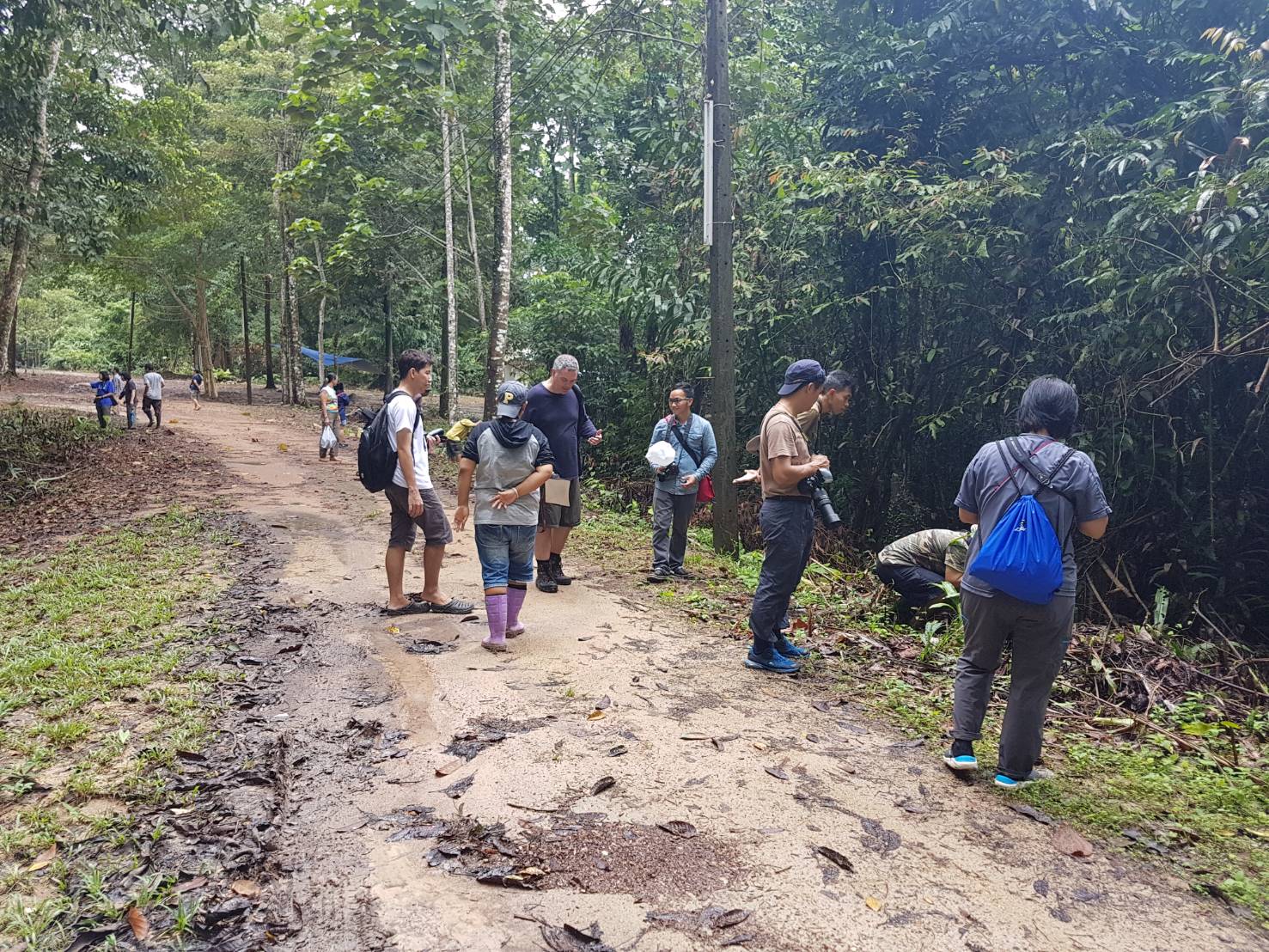
 The gang... (Lyriothemis sp. field in the background). Can you see me?
And eating... 
 My bungalow... very cute... deep discussion about Yingsak's 'yellow damsel' if memory serves correct!
A couple of 'action shots'...
Best shots of the trip...

Not new but sooooo cool, the micro Nannophya species... abundant in a paddy field...
 ...but the female is even more handsome and my first sighting...
Tetrathemis irregularis hyalina, female... I am now happy that I have seem in at Khao Yai. However... I saw about 5 males and walked past them all. What an idiot!!!
Certainly not rare anywhere... but they don't come much more beautiful than this. Rhyothemis plutonia, male.
And not to leave out his cousin... Rhyothemis obsolescens, male
and finally I have a full wing shot of Neurothemis fluctuans, male... not common where I live, but very common here. 
Not that common in Issarn, but seemingly so here... Agrionoptera insignis insignis, male.
Probably the most common of all that I photographed but who cares? Copera marginipes, female 'ghost form' ... or just a teneral to most of us!
 Blue is the colour... why do I never see the blue males near home (they are green) and only here... Ceriagrion cerinorubellum, male

 And now the 'newbies'...
A lifer for me, the minuscule, Brachygonia oculata... what an awesome species that sparkled in the darkness!
...and one even knocked on the door to visit me... Macromia cupricincta, male
The 'surprise' of the trip... Orchithemis pulcherrima, youngish female. Known from more southerly reaches... shame I missed the male!
and abundant in a paddy field or two and in the same fields as the Nannophya species, Mortonagrion falcatum, male... weirdest location ever?
...and the female...
The 'reason' for the trip... Risiophlebia guentheri, male in seriously dull conditions in swamp...
 ...and the female...
... and the potentially new Lyriothemis species abundant in scrub... possibly the strangest location ever to find such a rarity! Though the other field will give it a run for its money!
The male...
...and the female...
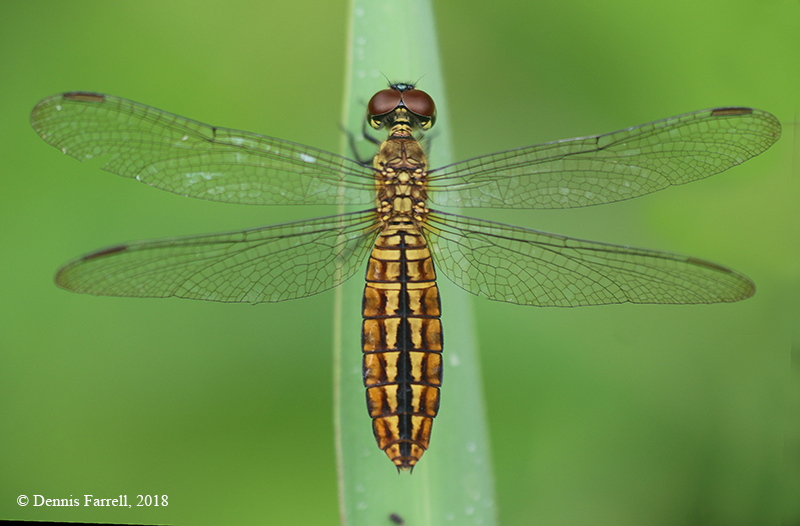
Finally, Noppadon may not like this but I don't care hahaha... 10 years in the making....
I would just like to thank everyone for making it such a wonderful experience... even though it was weird hunting for dragons in a group (my first time as I have done 10 years alone) and it was awesome... roll on the next trip!


 

Thursday, July 26, 2018

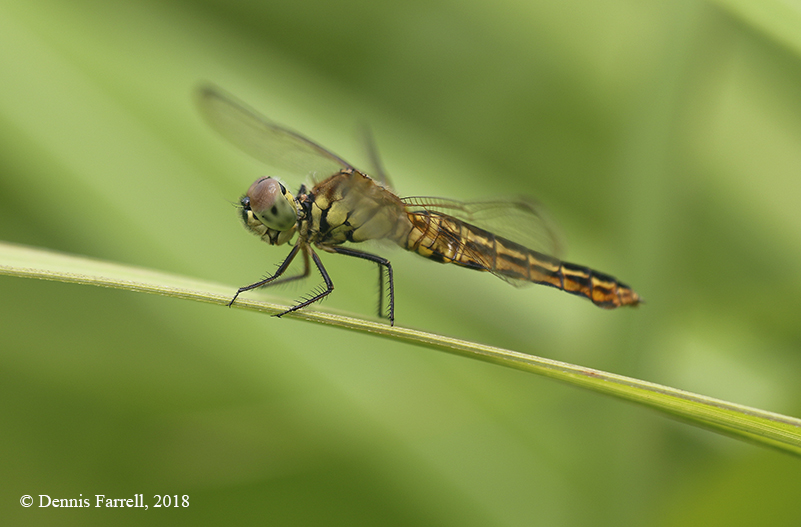
212: Lyriothemis pallidistigma Kompier, Holden & Makbun, 2021

Number: 212 / Family: Libellulidae / Genus: Lyriothemis
Species: Lyriothemis pallidistigma / Chanthaburi Wide-bellied Dragonfly*
Habitat: Open Grassy Fields
Provinces sighted: Chantaburi
Sightings (by me): Abundant (males and females) at one location
In flight: July
Species easily confused with: Lyriothemis elegantissima, Lyriothemis sp.

*As there isn't a common name, I decided to use part of the Thai name 'Chanthaburi' and there are quite a few names for the genus, such as Bombardier, Skimmer and Chaser. However, I think this genus deserves a more descriptive name so I decided to use a more descriptive 'Wide-bellied Dragonfly' (Lyriothemis: Wide-bellied Dragonfly), which is a more accurate description, so... the Chantaburi Wide-bellied Dragonfly. 

Right at the end of the last day, there was one last location to visit before heading home. Again, we were lead to the location by a fellow dragonfly hunter on Dragonflies of Thailand (Facebook Group). And, yet again, sadly I don't remember their name... but a million thanks anyway! Once we arrived, I was a little shocked. Just like the farmer's paddy field where there were numerous Mortonagrion falactum, this was just a simple field. Seriously, come one. There are millions like it it Khon Kaen. Boring, featureless fields. No way can a rare species reside there. It was a big field, granted, with a lot of long grass. But just a field like any other all the same. However, a female Lyriothemis species had been spotted there and it looked incredibly like L. pachygastra, the male of which I am desperate to see with its awesome blue markings. But I was not confident of seeing anything here. Not a chance. Anyway, there was lots of broken glass in the field and while some of the others put on more suitable footwear, I dived in... within about 5 seconds I came across a female. Amazing! Then a male. Then two more. In fact, they were everywhere! Loads of Lyriothemis out in the open. Why? How? Who? What? What was going on? Who knows? But, there they were, as happy as anything. Within a very short space of time and with everyone well and truly sated with their shots, it was apparent that it wasn't L. pachygastra. It was something else. L. elegantissima was mentioned as was the species I had seen in Phu Khieo, though I wasn't entirely convinced. Upon returning home (and others also collected a few specimens), I began to compare my photos with the ones from PK. The genitalia was slightly different and there were a few other subtle differences. I am convinced it is NOT that species. Then, upon finding Tom's blog (as usual hehe) I notice that he had already posted wonderful photos of L. elegantissima.. it was very similar and found in a similar habitat but, most importantly, the genitalia is almost identical. So, L. elegantissima it was, yay!... though Noppadon still had his doubts ( he always does, haha).  

Since then, this species has now been described as Lyriothemis pallidistigma and is an amazing species.

The Male
Very similar to other red Lyriothemis species but the genitalia and markings are slightly different.


The Female
It is similar to the male but more yellowish in colour, though a few of us saw an orangish female.


A slightly older female...


... and a fully matured female?


...and a young female from a different angle...


Mr and Mrs Lyriothemis... something I saw a few times... the male with the female but not copulating. I wonder why? Copulated already and the male is protecting her? She isn't ready and he is waiting? They are just friends? 

211: Risiophlebia guentheri Kosterin, 2015

Number: 211
Family: Libellulidae
Genus: Risiophlebia
Species: Risiophlebia guentheri
Common Name(s): N/A 
Habitat: Forested swampy area
Provinces sighted: Krathing Waterfall (Chantaburi)
Sightings (by me): One male, one female
In flight: July
Species easily confused with: N/A

One of the reasons why the group trip was arranged was to see an incredible species that was recorded for the first time for Thailand just last year. Tiny and black (with yellow markings) and being at home in dull swampy areas, I actually missed it at first. Under heavy tree cover, the other Facebook guys were trying to point it out. They were all firing away and I still couldn't see it! Eventually, on a little stick, there it was: a tiny, dull species known as Risiophlebia guentheri. It is a rather peculiar species that obviously likes swampy areas and so far is only known from the one location in Thailand. Once I managed to get in a few decent photos in the gloom, I could see just how good it looked with its bulbous S1-2 of the abdomen and a curve to the remainder. Fortunately, for me (blind and stupid haha), it was fairly easy to approach. Once we made it back outside the swamp, a couple of the team were already happy in the fact that they, too, had found male and female! Aaarrrgh! They saw the female... and the lighting was much better outside. Amazingly, a second female was found and everyone managed to get in shots of both sexes, although the place was then shrouded in cloud as the rains moved in (you can see the rain on the female as I took photos before dashing for shelter).

The male
Identifiable by its diminutive size and that incredible bulbous section on the abdomen. Knowing how dark it was, I am very happy with these shots. 


The female
Similar to the male but has a more robust abdomen and the bulbous section is even more prominent (you can just see the rain on her abdomen). 


Many thanks to Noppadon Makbun for leading us to this species.


Monday, July 23, 2018

210: Mortonagrion falcatum Lieftinck, 1934

Number: 210 / Family: Coenagrionidae / Genus: Mortonagrion
Species: Mortonagrion falactum Hooked Midget
Habitat: Open Paddy Fields
Province(s) sighted: Chantaburi
Sightings (by me): Abundant at two locations
In flight: July
Species easily confused with: Mortonagrion aborense

Mortonagrion aborense is a fairly common species that can be found around the country and is often found in swampy areas, grassy ponds and lakes on the edge of forest and also deep under the protection of foliage. So... the same should be said for Mortonagrion falactum, right? Well, it couldn't be further from the truth! We were led by a Dragonflies of Thailand Facebook group member (sorry, I don't know the name but thank you sooo much) to all I can describe as being a regular farmer's paddy field in the middle of nowhere. It was a place you would most certainly drive straight past and not give it a second's thought. Not only that, one we got our eye in (the Facebook team) and we realised just how small it was, it was easy to spot them everywhere. It was also abundant in another farmer's field not too far away, which suggests any field that is similar in the location could well have many of them. So, once found and in fairly decent light (though was heavily cloudy with a storm brewing in the distance) getting photos shouldn't be a problem, right? Well, you couldn't be further from the truth. Being so small and there was a constant breeze making photography really tough. It was also quite skittish and we all had to wade through the rice fields to follow them. I managed to get a few decent photos in the end (as did everyone). However, I think we all felt a little dizzy in the end. 

The Male
Tiny, but beautiful. A species I didn't think I would ever get to see. The most distinctive feature is its blue patch on the abdomen. The appendages are also distinctive which probably give it its name.


The Female
The female is a lot duller in comparison, though there orange-brown thorax was pretty easy to pick out in the long rice fields. On closer inspection (though tough to see), it has slim blue stripes along the abdomen. There is also a feint patch on the abdomen like the male (though no way near as strong). 


 The 'Teneral' Female
I was also lucky enough to spot a teneral female (Noppadon saw teneral male but I missed it).