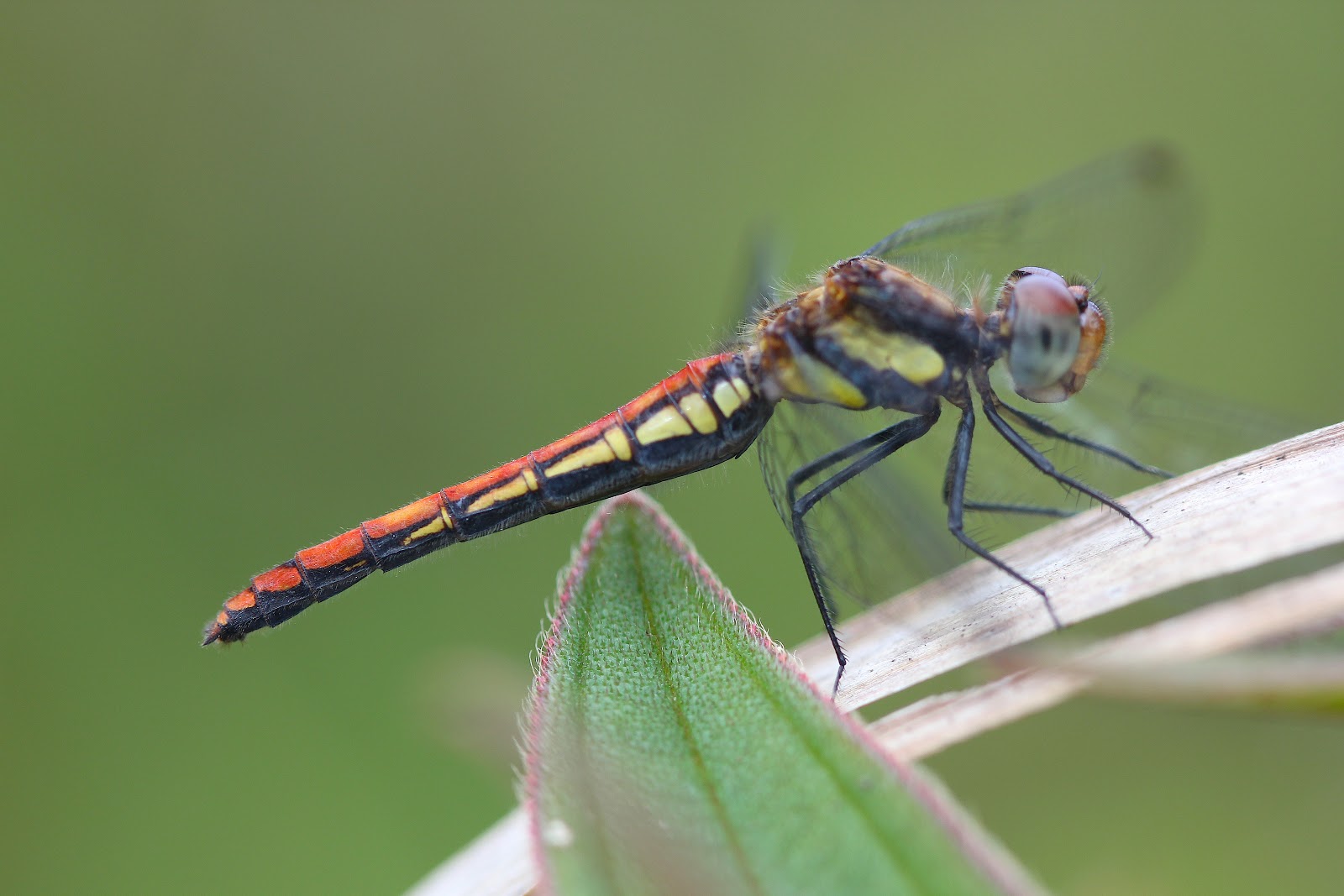
Location 1: Helicopter Pad Lake, Nam Nao National Park, Petchabun.
Date: Saturday, 27th September, 2012.
Weather: Hot, hotter, then hottest
Weather: Hot, hotter, then hottest
Expectations of recording additional species (for my list): zero
Leech bites: 4 (amazingly low)
Following on from my trip to Phu Kradueng, was a grueling trip to Nam Nao ... my legs were like jelly after the previous ordeal and every step was almost painful. Still, it turned out to be one of my better visits and the sun was shining from the moment I arrived - not a cloud in the sky. This ensured that there was lots of odonata activity. There were several new arrivals for the year and a couple of surprises. Diplacodes nebulosa and Trithemis pallidinervis were everywhere, as were Orthetrum pruinosum neglectum and Orthetrum glaucum. Neurothemis intermedia atalanta made its first appearance for a while, as did Aciagrion pallidum. Aciagrion tillyardi and Aciagrion borneense were in high numbers once more and Agiocnemis femina femina were everywhere. Pseudagrion australasiae and Pseudagrion microcephalum were present. However, the highlight of the lake was spotting 2 male Ceriagrion
cerinorubellum, followed by a solitary female late afternoon. This is the first time I have ever spotted the female and only the 2nd time I have spotted the male. It seems to be extremely scarce here. I have also spotted Ceriagrion
azureum here previously, yet I am to see one this year. Obviously they are rather rare indeed here. So, all in all, a great day, boosted by hordes of the usual suspects to keep my head spinning and constantly searching all day.
My best photos of the day:
Ceriagrion cerinorubellum, male - only my 2nd sighting


Ceriagrion
cerinorubellum, female - my first ever sighting

Pseudagrion australasiae, male - first sighting in a while

Pseudagrion australasiae, male close-up

Winter is here again ... Trithemis pallidinervis, male - making their first appearance for the year

Orthetrum pruinosum neglectum, male - they were very common this visit

Aciagrion borneense, male - much improved photo and now fairly common

Agriocnemis nana, female - my best female photo yet

Diplacodes nebulosa, male - they are everywhere now

... as too are the females

Agiocnemis femina femina, almost mature male

Agiocnemis femina femina, teneral female

Agiocnemis femina femina, very old female

Pseudagrion rubriceps rubriceps, female

Now she raises her abdomen ...

... and arches her abdomen ...

The reason ... an annoying male Aciagrion tillyardi.


Keep away from me!

Nam Nao Helicopter Pad (added species from the last visit, bold; new species for the lake, blue; species not seen from last visit, red)
Fam. Coenagrionidae
Aciagrion tillyardi ♂ [extremely common]
Aciagrion borneense ♀♂ [fairly common]
Aciagrion pallidum ♂ [1]
Aciagrion pallidum ♂ [1]
Agriocnemis femina femina ♂ ♀ [very common]
Agriocnemis nana ♀♂ [uncommon]
Argiocnemis rubescens rubeola ♂♀ [fairly common]
Ceriagrion cerinorubellum ♂♀ [2, 1]
Ceriagrion indochinense ♂ [1]
Ischnura senegalensis ♂ ♀ [very common]
Onychargia atrocyana ♂ ♀ [fairly common]
Pseudagrion microcephalum ♂♀ [1, 1]
Pseudagrion australasiae ♂ [2]
Pseudagrion rubriceps rubriceps ♀ [1]
Pseudagrion rubriceps rubriceps ♀ [1]
Fam. Platycnemididae
Copera ciliata ♂ ♀ [extremely common]
Copera marginipes ♂♀ [common]
Fam. Protoneuridae
Prodasineura autumnalis ♂ ♀ [common]
Fam. Gomphidae
Ictinogomphus decoratus ♂ [common]
Fam. Libellulidae
Acisoma panorpoides panorpoides ♂ ♀ [very common]
Brachydiplax farinosa ♂ ♀ [♂ very common]
Brachydiplax farinosa ♂ ♀ [♂ very common]
Brachythemis contaminata ♂ ♀ [very common]
Crocothemis servilia ♂ ♀ [fairly common]
Diplacodes nebulosa ♂ ♀ [very common]
Diplacodes trivialis ♂ ♀ [common]
Indothemis carnatica ♂ [2]
Indothemis limbata (Selys, 1891) ♂ [♂ extremely common]
Neurothemis intermedia atalanta ♂ [1]
Orthetrum pruinosum neglectum ♂ [common]
Neurothemis tullia tullia ♂ ♀ [common]
Orthetrum glaucum ♂ [common]
Orthetrum sabina sabina ♂♀ [very common]
Rhodothemis rufa ♂ [common]
Tholymis tillarga ♂ [3]
Trithemis aurora ♂ ♀ [extremely common]
Trithemis pallidinervis ♂ ♀ [fairly common]
Location 2: Stream at the Heaquarters, Nam Nao National Park, Petchabun.
Date: Saturday, 27th October, 2012.
Weather: Extremely hot, but still dull along the stream (except in certain places)
Weather: Extremely hot, but still dull along the stream (except in certain places)
Expectations of recording additional species (for my list): medium
Leech bites: 0
So, walking along a [seriously low even for the end of October] stream when I have NO power after Phu Kradueng and then the Helicopter Pad lake ... great idea. Especially when I spot a new species for the stream and I am knackered. Rhinagrion viridatum made an amazing appearance. I fact I saw 2 males. I haven't seen this species here in about 15-20 trips. It isn't a provincial record, however, as Noppadon Makbun saw it here 3 years ago. Still, a record for me anyway!
Then I saw two in one day - right next to me. In fact, almost too close to photograph and in blazing hot sunshine .... I think what I got was OK. This one was basking in the sunshine (the only bit of sunshine around). Amazingly, I went on to spot a second specimen. Wow ... this genus continues to amaze me. Other than that, the 4 Coeliccia species were clearly present and very common. I also saw 2 Tetrathemis platyptera. They are clearly around now. A solitary Prodasineura auricolor was still present, though it is clear that this species won't be around for long. I also saw 1 Orthetrum species, though it could have been any as it was on the other bank. The only other thing of note was the sheer volume of Copera vittata vittata copula ... I even managed to get a half-decent shot. I am 'well chuffed' as they say in Manchester.
Then I saw two in one day - right next to me. In fact, almost too close to photograph and in blazing hot sunshine .... I think what I got was OK. This one was basking in the sunshine (the only bit of sunshine around). Amazingly, I went on to spot a second specimen. Wow ... this genus continues to amaze me. Other than that, the 4 Coeliccia species were clearly present and very common. I also saw 2 Tetrathemis platyptera. They are clearly around now. A solitary Prodasineura auricolor was still present, though it is clear that this species won't be around for long. I also saw 1 Orthetrum species, though it could have been any as it was on the other bank. The only other thing of note was the sheer volume of Copera vittata vittata copula ... I even managed to get a half-decent shot. I am 'well chuffed' as they say in Manchester.
Here are the [very few] decent shots I took:

Rhinagrion viridatum, male - close up and with blazing sunshine coming from the other side. Not ideal for photography, but this turned out OK.

An amazing feat for me ... managing to get a decent photo of a Copera vittata vittata copula for the first time ever.

Nam Nao Headquarter's stream (added species from the last visit, bold; new species for the stream, blue; species not seen from last visit, red)
Family: Chlorocyphidae
Rhinocypha biforata ♂ ♀ [very common]
Rhinocypha fenestrella ♂ ♀ [uncommon]
Family: Euphaeidae
Euphaea ochracea ♂ ♀ [common]
Family: Megapodagriondae
Rhinagrion hainanense
Rhinagrion hainanense
Rhinagrion viridatum ♂ [2]
Family: Gomphidae
Gomphidictinus perakensi
Merogomphus paviei
Family: Platycnemididae
Coeliccia chromothorax ♂ ♀ [uncommon]
Coeliccia didyma ♂ ♀ [♂ very common]
Coeliccia c.f. loogali ♂ ♀ [♂ very common]
Coeliccia poungyi ♂ ♀ [♂ very common]
Copera marginipes ♂ ♀ [very common]
Copera vittata ♂ ♀ [very common]
Family: Protoneuridae
Prodasineura auricolor ♂ [1]
Family: Libellulidae
Zygonyx iris malayana