Sunday, July 17, 2011

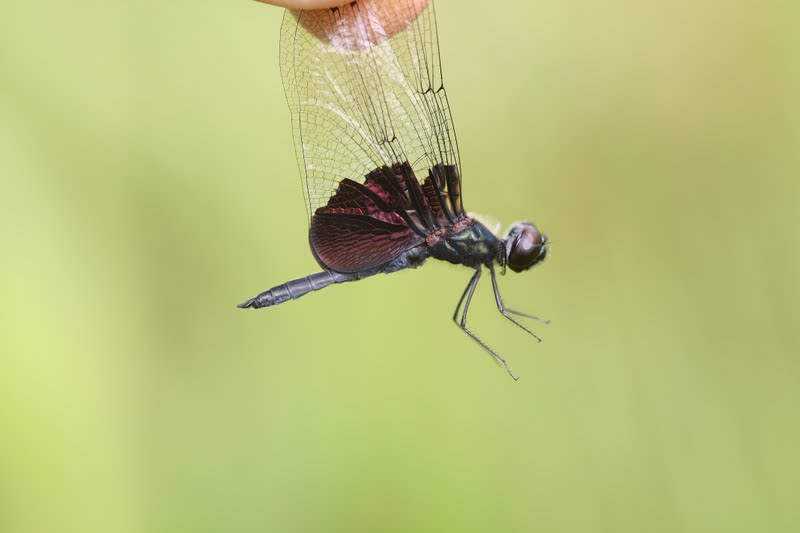
130: Rhyothemis obsolescens (Kirby, 1889)

Number: 130 / Family: Libellulidae / Genus: Rhyothemis
Species: Rhyothemis obsolescens / Bronze Flutterer
Habitat: Forested Ponds, Lakes and Marshland
Province(s) sighted: Chaiyaphum, Chantaburi, Nakhorn Ratchasima, Petchabun 
Sightings (by me): Locally Common
In flight (that I have seen): June-August

I have just returned from a 2-day trip to Khao Yai National Park. I visited there for the first time, back in April and it was rather quiet, although I did manage to spot one or two new species. This time, however, I faired rather better. Torrential rain, armies of hungry leeches, heavily swollen rivers and inaccessible areas I had previously visited, didn't put me off (though my girlfriend stayed in the rented car most of the time). And it was worth it. I managed to spot a few more specimens, as well as a lot of non-odonata related things and I had a great time. 

I had been driving around Khao Yai National Park all day and right at the death, I noticed a slow-moving, but swollen river about 900 metres up or so. I chanced my arm and drove towards it. I then noticed it was part of a campsite I hadn't even noticed before. There was a beautiful river that ran though it, shrouded by tall, large lilly pads. I saw a few species and decided I needed a full day there and so planned to camp there with my girlfriend in the next few weeks. As I walked back, I noticed something that looked a little like Neurothemis fulvia. Then I realised... it was a species I had been after for a long time, Rhyothemis obsolescens. I followed the male for long periods, trying to get close to it, but it fluttered further along the lilly pads every time. I followed it about 40 metres downstream and then noticed that there were a few more specimens. Almost waist-deep in mud, I managed to get close enough to get a few half-decent photos, much to the amusement of the camping Thais, and the embarrassment of my girlfriend. So, there you have it... all 5 species in the Rhyothemis genus! I couldn't be happier. 

Since then, I have returned and found both male and female and seen this species quite a few times... though I never tire of seeing it!

The Male
From a distance, the male looks much more boring than its cousins. However, on closer inspection, its a vivid bronze with lots of dazzling variants in colour and patterns on its wings. It really is a truly magnificent creature.


In the hand...
I managed to capture a young male. As you can see, they are small, but no less beautiful.


The Female...
The female is identical to the male, except its abdomen is more robust. 


This one has a damaged forewing.


Here is another young female...


Now in hand...this shows just how similar the female is to the male.

Sunday, July 10, 2011

129: Ceriagrion azureum (Selys, 1891)

Number: 129 / Family: Coenagrionidae / Genus: Ceriagrion
Species: Ceriagrion azureum / Azure Marsh Dart
Habitat: Often Exposed, but Weedy Areas of Upland Ponds / Lakes
Province(s) sighted: Chaiyaphum, Petchabun
In flight: June-October / Sightings (by me): Locally Common
Species easily confused with: N/A

My 9th species in the genus Ceriagrion! I returned to Nam Nao Helicopter Pad at National Park, in search of the female, Indolestes inflatus and I was surprised to find a new species for my records... Ceriagrion azureum, commonly known as the Azure Marsh Dart.

It was an amazing thing to see. Well, basically, you couldn't miss it. As far away as possible from the entrance to the lake, was an area where the lake shallowed up and was heavily covered by trees. I had caught a male Brachydiplax and was photographing the genital plate for correct ID. Then I saw it. A bright blue stick moved across the shallow and very weedy area. You couldn't miss it. It was clearly Ceriagrion and the only thing that possibly matches is Ceriagrion azureum. It's actually very large for Ceriagrion and the colours are not Ceriagrion like, but it has to be the most beautiful one of all (maybe because I'm a Man City fan). I then searched the whole area for a few hours. I managed to see a second male, as well as a number of other species, but the thousands of leeches biting and heavy storm brewing, cut short my day. 
Since then I have returned to the same place and was lucky to spot 4-5 males in a small area late on June afternoon - though I still didn't spot the female. Since posting this, I have spotted this species regularly, especially in the Chaiyaphum/Petchabun mountain range, where it can be quite common at times.

The Male
It is easy to see why it is called C. azureum... it is basically completely azure blue. Only S9-10 and the caudal appendages are black. The stigma is black too and the wings are hyaline.


The 'Young' Male
This male is a more whitish-green colour and most of the time you don't see any, but on certain days, you can see many of them flying around... many of which are in tandem! But getting a photo is another story as they are so skittish at this stage.


The Female
Though I have seen a fair few tandems, I seldom see the female. Fortunately, this one had just finished copulating and I managed to get a few shots in before she took off in the wind and disappeared forever. The female is similar to most in the genus, but is uniform pale olive green. However, older females turn blue like the male. This female is cleaning off after copulation.


The Copula
This is my one and only copula that I have managed to get near. They are usually so, so skittish.


The Tandem
Though I have seen it quite regularly, getting photos of the tandem is tough...


Tuesday, July 5, 2011

128: Indolestes inflatus (Fraser, 1933)

Number: 128 / Family: Lestidae / Genus: Indolestes
Species: Indolestes inflatus / Red-veined False Spreadwing*
Habitat: Upland Ponds / Lakes
In flight: March-July
Province(s) sighted: Petchabun / Sightings (by me): Rare
Specieas easily confused with: All Indolestes Species 

*As there is no common name, I have based the first part on 'Red-veined' which comes from the Thai name and 'False Spreadwing' which I have raised for Indolestes as they keep their wings closed, unlike other Spreadwings, creating the Red-veined False Spreadwing.

AT LAST!!! I have discovered a new record for Thailand! I saw this rare specimen at the Helicopter Pad lake, Nam Nao, late in the afternoon. It was extremely skittish and I managed only to get a few shots, before it chased a tiny damselfly deep into the bushes and I didn't see it again. When I returned home, I knew it was of the genus Indolestes and I thought it was I. anomalus. Primarily because I had already seen I. birmanus at Phu Kradueng NP on two previous occasions. And there are only two species of that genus recorded in Thailand... or so I thought. I sent the photos to Dr. Matti Hämäläinen and he forwarded the photos to Dr. Rory Dow, who confirmed it as Indolestes inflatus,  a very rare species, where only one male specimen has ever been recorded in Burma, 1925. In Fraser's field notes, he stated: "Distribution - a single adult male from Maymyo, North Shan States, Burma, collected by Col. F. Wall, 5. vi. 25, now in the author's collection." Also in his field notes, the species was referred to as Ceylonolestes inflata.  A copy of the field notes were kindly emailed to me by Dr. Matti.

Since then, I have returned to the same place and I recorded 3 more males and a female, which has never been seen or recorded before! They seemed more active very early in the morning. I saw the males and the female at about 7.00 am. By the time I had walked around the lake, they had all but vanished, probably hiding from the hot sun.

The Male
Slightly smaller than I. birmanus, the male is distinct in that it has a azure blue thorax and eyes. The wings are a distinct brownish colour, as is the stigma. The abdomen is blue with unique blackish markings dorsally. S8-10 are black and the caudal appendages are white and rather distinct.


The Female...
Never before seen! I was amazed not only to see the male again, but I even managed to see, for the first time, the female and a copula. I saw the copula first, and then I think this is the same female, after copulation.

The female is very similar to the male, except it is much paler. It has brownish wings and legs. The thorax is a greenish/brown to a blueish/creamy colour and has a prominent dark thoracic stripe dorsally, as with the male. The markings on the abdomen are the same as the male and has a slight blueish tinge. The caudal appendages are white and unique.

I have since spotted a second female. Again, like the first female, she was active very early in the morning before the sun came up properly.


Once she got used to me, she began slowly prodding her ovipositor into various reeds in a small area, which overhang an area that floods. Here you can see the difference as the sun comes out (above) and how dull it really is when tucked behind clouds.

Here is the female as part of a copula


Female, in the hand (maybe I'm the only person to ever hold a female!)


Female appendages

Dorsal ...


Lateral ...


Here, ovipositing...


And the copula... very early in the morning.

In tandem...


... and now the wheel.

                                                       
Special thanks to Dr. Matti Hämäläinen and Dr. Rory Dow for their help in identification.

127: Rhyothemis triangularis (Kirby, 1889)

Number: 127 / Family: Libellulidae / Genus: Rhyothemis
Species: Rhyothemis triangularis / Asian Sapphire Flutterer
Habitat: Exposed Marshland, Ponds and Shallow Lakes (Mostly Uplands)
Province(s) sighted: Chaiyaphum, Petchabun, Nakhorn Ratchasima.
Sightings (by me): Locally common
In flight (that I have seen): April-September
Species easily confused with with: N/A

One of my favourite genus is Rhyothemis and it has just got even better for me. I managed to spot and photograph Rhyothemis triangularis for the first time and it is incredibly beautiful close up. I saw several of the species at the Helicopter Pad lake, Nam Nao. Fortunately for me, the wind was strong, forcing many of species to land and hold onto the grasses and weeds. 
I managed to get very close (the photos are uncropped) to the species and take some photos and I instantly fell in love with it. Although it seems much smaller in real life than I thought, it still looks extremely beautiful. On the second day (with little wind), they resumed their fluttering in the air for long periods, similar to that of the other species in the genus. 
Since then, I visited a number of ponds along the roadside on the way to Nam Nao town (road 2116, I think). At every pond - mostly farmer's ponds - there were one or two present. However, just 1 kms outside Nam Nao town, there was a cluster of ponds/marshland and there were literally hundreds of them! Since then, I have seen this species quite regularly at a number of places and will list all provinces eventually.

The Male
Simply beautiful. That's all I really have to say. It can't be mistaken for any other species. The base of the wings are a bluish purple. The stigma is also the same, as is the thorax and the abdomen.


In hand. The wings are much darker on the underside.


The 'Teneral' Male
On this day, hundreds of specimens emerged, both male and female (see female below) but they were poor fliers. It looks identical to the mature male but looks at those wings glisten!


The Female...
Not only did I see hundreds of males at a marshland, near Nam Nao town, I also saw a few females which only land briefly after copulation.


The 'Teneral' Female
Like with the teneral males (above), the females simply look like the mature females but have that glorious shimmer on the wings.


An amazing thing...
This is another female I managed to capture with my net. As I held her up to photograph her, eggs started pouring out. The difference in time with the below two photos is about 15-20 seconds. When I released her, she flew straight down to the water and dropped them into the water, before flying high back into the treetops. I wonder if the female can't stop producing/releasing eggs, once she has started.


The copula...
I even managed to spot and photograph a copula (though not the best photo in the world). Bear in mind that they always land deep in the rushes and it only lasts for a few seconds, then they split. So, not a bad effort really.

126: Ceriagrion cerinorubellum (Brauer, 1865)

Number: 126 / Family: Coenagrionidae / Genus: Ceriagrion
Species: Ceriagrion cerinorubellum / Orange-tailed Marsh Dart
Habitat: Exposed Upland and Lowland Ponds and Lakes
Province(s) sighted: Widespread
Sightings (by me): Common
In flight (that I have seen): April-November 

Number 8! Yes, number 8 of 12 from the genus Ceriagrion... this time in the shape of the beautiful Ceriagrion cerinorubellum. This is a species that I have wanted to see for a long time and only had a very short time to see it. Just one photo, and it was gone. Confident I would see more, including the female, I searched the area, but to no avail. That really was it. Just one specimen. No idea why. Maybe it was a bit of a vagrant and was just being nosey. Maybe I am too early in the season. I will hopefully find out as I am to return to the area again on Saturday. I want to take photos from different angles and also would like to see the female. I can only hope! I now only need to add the following to my blog: C. azureum, C. calamineum, C. nigroflavum, C. pallidum and possibly C. malaisei (though this could be the one I have already found - the photos are not the best for identification). If anyone knows where I can find these species (or even has photos of them for ID purposes), please let me know... I will travel anywhere to see them. Since then, I have seen all of those I was desperate to see, except C. nigroflavum, which is possibly a misidentification or it is extirpated... or simply just really rare and no-one has found it! Hopefully the latter and it is found one day. Furthermore, I have now seen this species many times throughout Thailand and it is rather common.

The Male
The male really is stunning and I saw it at the water's edge at the Helicopter Pad lake 2 kms from the entrance of Nam Nao National Park. I don't think that it can be mistaken for any other species. The caudal appendages are very long for this genus too. It's eyes and thorax are bright green (and can go more of a blue I think). S1-3 are orange, as well as part of S7-10. The caudal appendages are also orange.


... and a close-up of the first 'blue' male, I saw at Khao Kitchacut NP. This, I believe, is a fully mature male.


The female ...
I saw the female for the first time at Nam Nao NP. However, I have since spotted a number of females at Khao Kitchacut NP. Finally, I have some decent photos.


Here is a more greenish specimen.


The 'Teneral' Female
The newly emerged female looks similar to the older females, but you can tell she is fresh due to her wings.